
Syllabus: GS Paper III – Indian Economy: Indian Economy and issues relating to planning, mobilisation of resources, growth, development and employment.
In News
The concept of “animal spirits” is relevant for understanding what drives corporate investment and why businesses may increase or postpone investment even when economic fundamentals such as interest rates remain favourable.
What are ‘Animal Spirits’?
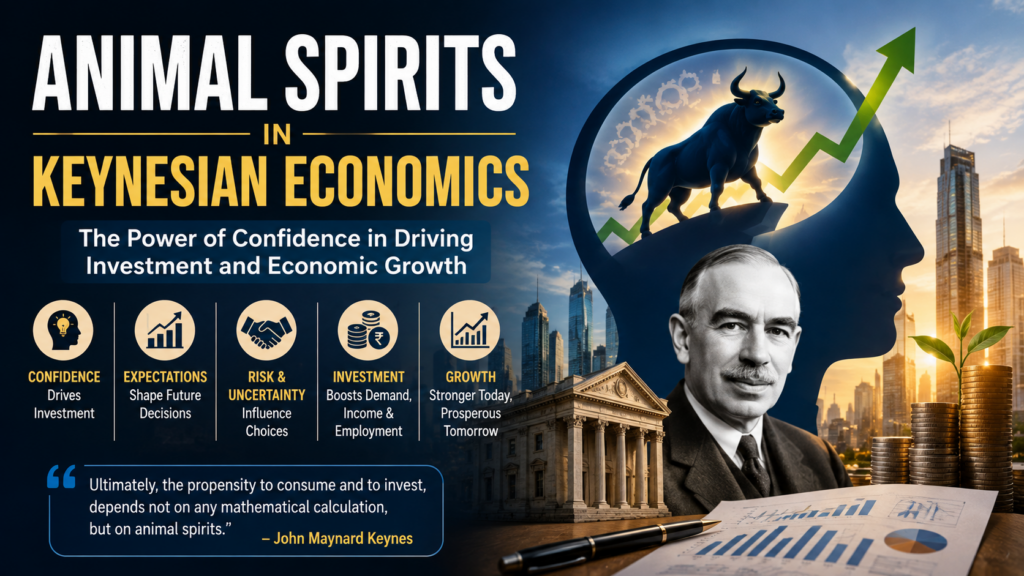
In Keynesian economics, animal spirits refer to the psychological impulses, optimism, confidence and expectations that influence entrepreneurs when making investment decisions under uncertainty.
John Maynard Keynes argued that investment decisions are not determined solely by interest rates or expected profits. Business confidence and expectations about the future play a crucial role.
Entrepreneurs operate in an environment where future demand, prices, government policies and profits cannot be known with certainty. Therefore:
Optimism → Greater willingness to invest
Pessimism → Postponement or cancellation of investment
Thus, animal spirits help explain why investment can fluctuate significantly even when interest rates and other economic fundamentals remain relatively stable.
How Business Confidence Influences Investment
1. Expectations of Future Demand
When businesses expect higher consumption and sales, they are more likely to expand production capacity, purchase machinery and undertake new projects.
2. Expected Profitability
Greater confidence about future profits encourages firms to commit capital to long-term investments.
3. Risk Perception
Higher confidence reduces the perceived risks associated with investment. On the other hand, uncertainty regarding taxation, regulations, geopolitical conditions or economic growth can encourage businesses to adopt a wait-and-watch approach.
4. Access to Finance
Strong business sentiment can encourage borrowing and attract private capital. Conversely, weak sentiment can reduce credit demand even when interest rates are low.
5. Investment Multiplier Effect
Higher private investment generates demand for capital goods, employment and inputs. This increases incomes and consumption, which can further strengthen business confidence.
Impact on Economic Growth
A positive confidence-investment cycle can generate a virtuous cycle of economic growth:
Higher confidence
↓
Greater investment
↓
Higher aggregate demand and employment
↓
Higher incomes and consumption
↓
Higher demand and corporate profitability
↓
Further investment
Conversely, pessimism can create a negative cycle where weak expectations reduce investment, employment and demand, reinforcing an economic slowdown.
Relevance to India
India’s experience shows that low interest rates alone may not be sufficient to revive private investment.
Businesses may choose to conserve cash rather than undertake fresh capital expenditure when they face:
- Weak demand
- Excess capacity
- Policy uncertainty
- Concerns about future profitability
Therefore, strengthening domestic demand, ensuring policy stability and improving infrastructure can help restore business confidence and encourage private investment.
Way Forward
For sustained economic growth, monetary and fiscal policies should go beyond improving financial conditions. They should also create an environment that provides businesses with greater confidence regarding:
- Future demand
- Profitability
- Policy stability
- Investment opportunities
UPSC Perspective
The concept of animal spirits highlights the importance of expectations and confidence in an uncertain economy. It explains why private investment may remain subdued despite favourable financial conditions and why restoring business confidence is essential for sustained economic growth.
Key Takeaway:
Economic growth depends not only on the availability and cost of finance but also on business confidence, expectations and the willingness of entrepreneurs to invest.
PYQ Reference: UPSC 2016 – FDI and the gap between MoUs signed and actual FDI inflows.
Source: The Hindu – What drives corporate investment?