
|
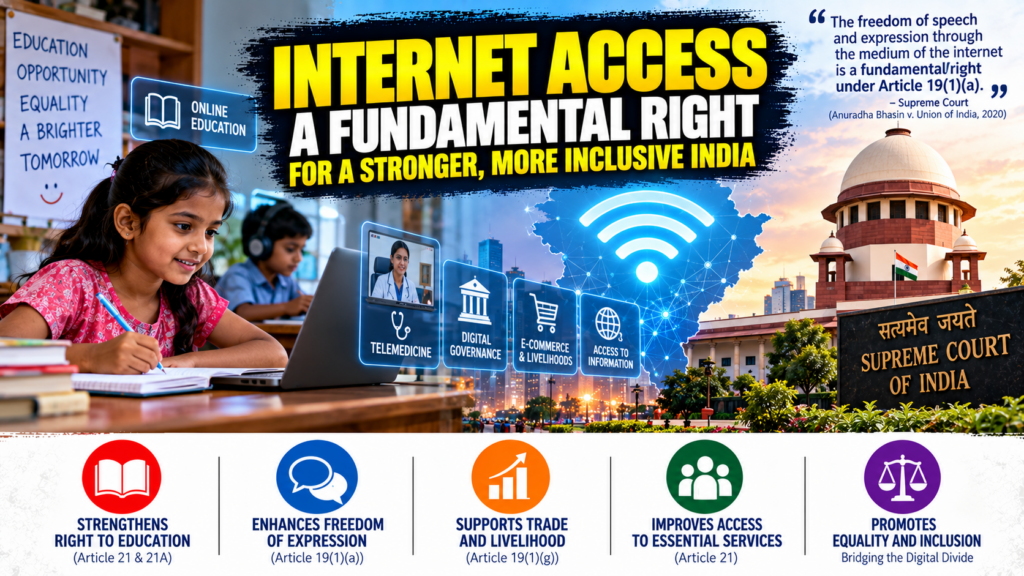
IN NEWS: Internet access as a fundamental right for children: What the Supreme Court ruling means
QUESTION: “The recognition of internet access as a fundamental right strengthens the substantive dimensions of Articles 19 and 21 of the Constitution.” Examine.
ANSWER: The recognition of internet access as a fundamental right—most notably articulated by the Supreme Court of India in Anuradha Bhasin v. Union of India (2020)—marks a pivotal evolution in Indian constitutional law. Rather than creating an entirely new right, the judiciary interpreted internet access as an essential catalyst that activates, protects, and expands the substantive dimensions of Article 19 (Freedom of Speech and Expression, Trade, and Profession) and Article 21 (Right to Life and Personal Liberty).
1. Strengthening Article 19: Enhancing Democratic & Economic Freedom
Article 19 guarantees fundamental freedoms, but in the digital age, these freedoms cannot be meaningfully exercised without digital infrastructure.
- Article 19(1)(a) – Freedom of Speech and Expression:
- Internet as a Medium: In Anuradha Bhasin, the Supreme Court held that the freedom of speech and expression through the medium of the internet is a constitutionally protected right under Article 19(1)(a).
- Democratization of Expression: The internet serves as a global forum for opinion, news dissemination, citizen journalism, and dissent. Recognizing internet access ensures that freedom of expression is not restricted to traditional, physical print or broadcast media.
- Article 19(1)(g) – Freedom of Trade, Commerce, and Profession:
- Digital Economy: Modern trade, e-commerce, banking, freelancing, and digital services rely entirely on internet connectivity.
- Protection of Livelihood: Arbitrary internet shutdowns paralyze small businesses, gig workers, and online platforms. Elevating internet access ensures that state restrictions on connectivity must satisfy the test of proportionality and reasonableness under Article 19(6).
2. Strengthening Article 21: Expanding Life with Dignity
Article 21 has evolved from mere animal existence to living a life with human dignity (Maneka Gandhi v. Union of India). Internet access directly enriches several implicit rights under Article 21:
- Right to Education (Article 21A & Article 21):
- The Kerala High Court in Faheema Shirin v. State of Kerala (2019) explicitly declared the right to access the internet as part of the Right to Education and Right to Privacy under Article 21.
- Internet access bridges educational divides, enabling online learning, access to research, and skill development.
- Right to Health and Essential Services:
- Telemedicine, online health consultations, emergency services, and digital welfare delivery (e.g., public distribution systems, direct benefit transfers) require reliable internet connectivity.
- Right to Information & Autonomy:
- An informed citizen is central to personal autonomy. Internet access empowers individuals to seek knowledge, make informed health/lifestyle decisions, and engage in self-development.
3. Substantive vs. Formal Rights: Bridging the Digital Divide
| Formal Right | Substantive Dimension (Enhanced by Internet Access) |
| Speech (19(1)(a)) | Freedom to publish ideas online and reach a global audience without arbitrary state blackouts. |
| Trade (19(1)(g)) | Equal capability for rural entrepreneurs, gig workers, and small sellers to access markets online. |
| Life & Liberty (21) | Meaningful access to digital healthcare, online education, e-governance, and public services. |
Challenges and Way Forward
- Frequent Internet Shutdowns: India continues to experience localized internet shutdowns. Ensuring that shutdowns are strictly proportionate, temporary, and subject to periodic review remains a critical challenge.
- Digital Divide: Structural inequalities in digital literacy, rural broadband infrastructure (e.g., BharatNet completion), and device affordability can turn a fundamental right into a privilege for the urban affluent.
- Data Privacy & Cybersecurity: Expanding internet access without robust privacy protections and safe digital spaces compromises personal liberty under Article 21 (Puttaswamy judgment).
|