
SYLLABUS: Science & Technology
General Studies – : III Science and Technology- Developments and their Applications and Effects in Everyday Life.
IN NEWS: Pioneer of Ice Cube neutrino detector wins physics Nobel
QUESTION: What are neutrinos? Why are they difficult to detect? Discuss how the detection of high-energy cosmic neutrinos has opened a new window for understanding the universe. (15 marks, 250 words)
ANSWER: The 2026 Nobel Prize in Physics, recognising pioneering work connected with the IceCube Neutrino Observatory, has brought renewed attention to neutrinos as a new means of studying the high-energy universe.
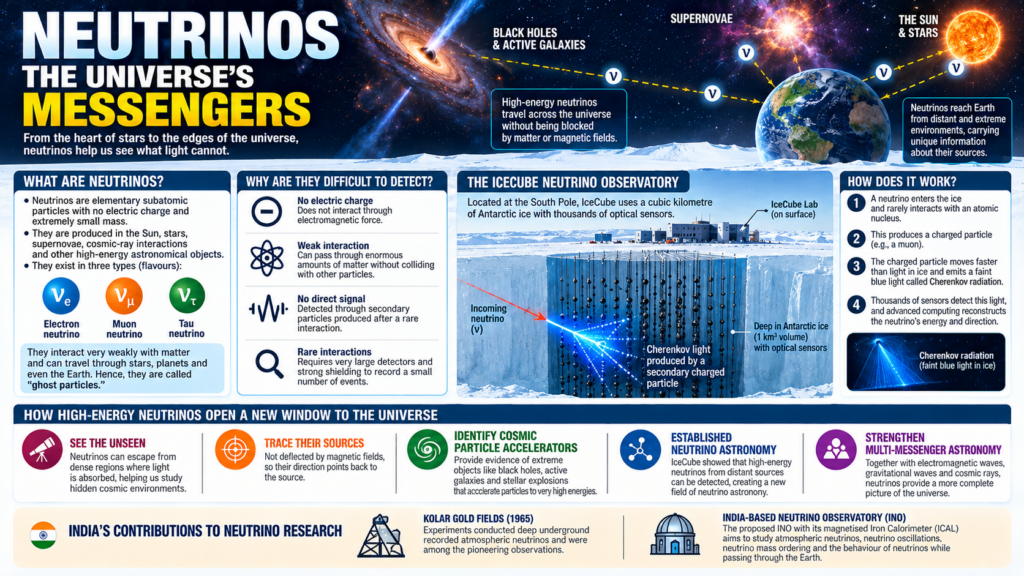
What are neutrinos?
- Neutrinos are elementary subatomic particles with no electric charge and an extremely small mass. They are produced naturally in nuclear and high-energy processes occurring in the Sun and stars, supernova explosions, cosmic-ray interactions and highly energetic astronomical objects.
- They occur in three forms, known as electron, muon and tau neutrinos.
- Their most important characteristic is that they interact extremely weakly with ordinary matter.
- For this reason, neutrinos can travel through stars, planets and even the Earth with very little disturbance. This is why they are popularly called “ghost particles.”
Why are neutrinos difficult to detect?
| Property of neutrino | Why does it make detection difficult? |
| No electric charge | It does not interact with matter through electromagnetic force like electrons or protons. So, they don’t respond to electromagnetic fields the way charged particles do. |
| Weak interaction with matter | A neutrino can pass through enormous amounts of matter without colliding with another particle. |
| No easily observable direct signal | Scientists usually detect the particles produced after a rare neutrino interaction rather than the neutrino itself. |
| Rare interactions | Very large detectors and strong shielding from other cosmic particles are needed to record a small number of neutrino events. |
Thus, the main difficulty is simple: neutrinos are abundant, but they very rarely interact with the material used to detect them.
How does IceCube detect neutrinos?
- The IceCube Neutrino Observatory at the South Pole uses about a cubic kilometre of clear Antarctic ice containing thousands of optical sensors.
- Cherenkov radiation is the faint blue light produced when a charged particle moves through a medium such as ice faster than light can travel through that medium. It does not mean that the particle travels faster than light in vacuum.
- The important point is that IceCube does not directly see the neutrino. It reconstructs the neutrino from the light created by the secondary charged particle.
How have high-energy cosmic neutrinos opened a new window on the universe?
- They allow us to study regions hidden from ordinary telescopes
- Most astronomy is based on electromagnetic radiation, including visible light, radio waves, X-rays and gamma rays.
- However, light can be absorbed, scattered or blocked by dense matter surrounding an astronomical object. Neutrinos interact only weakly with matter and can escape from such regions.
- They can therefore carry information from deep inside energetic cosmic environments that may be difficult to study using light alone.
- They help identify the source of high-energy cosmic particles
- Cosmic rays are mainly charged particles. Their paths are bent by magnetic fields while travelling through space, making it difficult to determine where they originated.
- Neutrinos have no electric charge, so magnetic fields do not significantly deflect their paths.
- Therefore, the direction from which a high-energy neutrino reaches Earth can help scientists trace it back towards the cosmic object that produced it.
- They reveal natural cosmic particle accelerators
- Extremely energetic environments around black holes, active galaxies, blazars and stellar explosions can accelerate particles to energies much greater than those produced in human-made accelerators.
- High-energy interactions in such environments can also generate neutrinos.
- Their detection therefore provides evidence about where and how the universe accelerates particles to extremely high energies.
- They established neutrino astronomy
- The major change brought by IceCube was not the discovery of neutrinos themselves. Neutrinos had been known much earlier.
- The breakthrough was demonstrating that very high-energy neutrinos arriving from distant astrophysical sources could be detected and their direction studied.
- This transformed the role of neutrinos:
- Earlier: Neutrinos were particles whose properties were studied.
- Now: Neutrinos can also be used as messengers to study distant astronomical objects. This has created the field of neutrino astronomy.
- They strengthen multi-messenger astronomy
Different cosmic signals reveal different aspects of the same event.
| Cosmic messenger | What it tells us |
| Electromagnetic radiation | Radiation and observable properties of astronomical objects |
| Gravitational waves | Violent motion and merger of massive objects |
| Cosmic rays | High-energy charged particles |
| Neutrinos | High-energy particle interactions occurring at or near the source |
Studying an event through several such signals is called multi-messenger astronomy. It provides a more complete understanding of phenomena such as black holes, stellar explosions and energetic galaxies.
Thus, IceCube solved an unusual scientific problem: the particles that are hardest to detect on Earth are valuable precisely because they can travel through the universe almost undisturbed.
High-energy neutrinos can preserve information about both the direction and energetic processes of their source. IceCube has therefore added neutrinos to humanity’s set of cosmic messengers, opening access to regions and processes of the universe that conventional astronomy alone could not fully reveal.
Additionals:
India in neutrino research
India has a long association with neutrino physics.
Kolar Gold Fields: In 1965, experiments conducted deep inside the Kolar Gold Fields in Karnataka recorded atmospheric neutrinos and were among the pioneering observations of such particles. The underground location reduced interference from ordinary cosmic radiation.
India-based Neutrino Observatory: The proposed INO, with its magnetised Iron Calorimeter or ICAL, is primarily intended to study atmospheric neutrinos. Its scientific goals include understanding neutrino oscillations, neutrino mass ordering and the behaviour of neutrinos while passing through the Earth.
PYQ REFERENCE UPSC 2021 The Nobel Prize in Physics of 2014 was jointly awarded to Akasaki, Amano, and Nakamura for the invention of Blue LEDs in the 1990s. How has this invention impacted the everyday life of human beings? (15 M ; 250 Words)
SOURCE: The Hindu e-paper – Pioneer of IceCube neutrino detector wins physics Nobel