
|
IN NEWS: Why are States divided over the mining amendment?
QUESTION: What constitutional mechanisms are available to States to challenge a Union law that they believe encroaches upon their legislative or fiscal domain? Discuss(250 words)
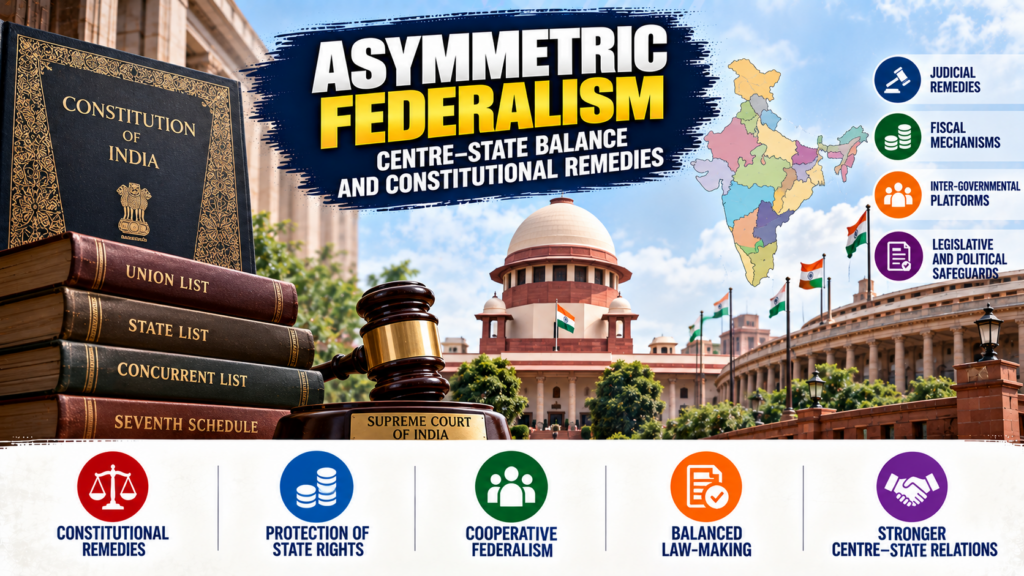
ANSWER: Under the scheme of asymmetric Indian federalism, while the Union holds overarching legislative and fiscal dominance, the Constitution provides States with judicial, legislative, deliberative, and political remedies to challenge central legislation that encroaches upon their constitutional domain.
Judicial Mechanisms
- Original Jurisdiction of the Supreme Court (Article 131): States can directly file an original suit in the Supreme Court against the Union if a dispute involves a fundamental question of law or legal right concerning federal jurisdiction (e.g., State of West Bengal v. Union of India, 1963).
- Judicial Review and Constitutional Doctrines: States can challenge Central statutes before the Higher Judiciary invoking specific judicial doctrines:
- Doctrine of Pith and Substance: To prove that the “substance” or true nature of a Union law falls within List II (State List) of the Seventh Schedule, rendering any encroachment impermissible.
- Doctrine of Colorable Legislation: To demonstrate that Parliament has indirectly legislated on a State subject over which it has no direct competence (“what cannot be done directly cannot be done indirectly”).
- Writ Jurisdiction under Article 226: State instrumentalities or aggrieved bodies can approach High Courts seeking writs of Certiorari or Mandamus to strike down central statutory notifications or rules that violate legislative competence or fundamental rights.
Fiscal and Statutory Mechanisms
- Challenge to Money Bill Classification: States can challenge Parliament’s misuse of Article 110 (Money Bills) to bypass the Rajya Sabha—the federal chamber representing State interests—on legislations impacting state revenue or administration.
- GST Council Institutional Mechanism (Article 279A): For taxation disputes, States can utilize the voting and dispute-resolution framework within the GST Council to contest central tax structures, rate changes, or delayed compensation cesses that erode State fiscal autonomy.
- Presidential Assent and Repugnancy Remedies (Article 254(2)): On Concurrent List (List III) subjects, if a Central law encroaches on a State’s legislative domain, a State Assembly can pass a counter-statute. If it receives Presidential assent, the State law prevails over the conflicting Union law within that specific State.
Deliberative and Inter-Governmental Platforms
- Inter-State Council (Article 263): States can invoke Article 263 to demand formal discussion and investigation into central laws that undermine cooperative federalism, seeking consensus-based policy amendments.
- NITI Aayog Governing Council: Provides a platform for Chief Ministers to collectively raise structural grievances regarding Central Sector Schemes (CSCs) and Centrally Sponsored Schemes (CSSs) that tie up State revenues or enforce federal mandates without fiscal devolution.
Political and Legislative Safeguards
- Rajya Sabha as the Federal Check: States leverage their representatives in the Council of States to vote down, amend, or refer controversial central bills to Parliamentary Select Committees before they become law.
- Resolution in State Assemblies: State Legislatures can pass official resolutions under Parliamentary conventions rejecting the applicability of central statutes (such as resolution filings against agricultural or central taxation laws) to build constitutional and moral pressure on the Union.
Way Forward
- Enforcing Sarkaria and Punchhi Commission Recommendations: Strengthen the Inter-State Council into a permanent, mandate-driven body to consult States prior to introducing legislation on List III (Concurrent List) items.
- Clarifying Article 131 Scope: Establishing specialized federal benches in the Supreme Court for faster adjudication of Article 131 disputes to prevent protracted legislative friction between the Centre and States.
|
SOURCE: The Hindu e-paper – Why are States divided over the mining amendment?