
|
IN NEWS: Disabled citizens and the future of AI
QUESTION: Accessibility should be treated as a fundamental component of the right to dignity rather than as a welfare measure. Discuss in the context of persons with disabilities and emerging technologies.(250 words)
ANSWER: The transition from viewing accessibility as a welfare concession to recognizing it as a fundamental component of human dignity marks a critical paradigm shift. Historically framed through a charity model, accessibility was treated as an optional accommodation. Today, in a digital-first world where technology governs livelihoods, education, and civic engagement, accessibility is an indispensable prerequisite for human dignity, protected under Article 21 (Right to Life and Dignity) of the Indian Constitution, the Rights of Persons with Disabilities (RPwD) Act, 2016, and Article 3 of the UNCRPD.
According to the 2011 Census, India is home to 2.68 crore Persons with Disabilities (PwDs) (approx. 2.21% of the population), while global estimates by the WHO (2022) place the figure at 16% of the global population (1.3 billion people). Treating digital and physical access as a discretionary benefit ignores this massive demographic, effectively marginalizing millions from economic and social life.
Shift from Welfare to Dignity-Based Approach
- Critique of the Welfare Model: The welfare approach treats accessibility as state benevolence or post-facto charity. This leads to reactive, piecemeal measures—such as adding a ramp as an architectural afterthought or retrofitting legacy software—rather than embedding inclusion into foundational design.
- The Dignity Framework: Dignity demands individual autonomy, privacy, and self-determination. Forcing a person with a disability to rely on continuous human assistance due to inaccessible infrastructure violates their inherent self-respect and right to independent living.
- Judicial Precedent: In Vikash Kumar v. UPSC (2021), the Supreme Court of India held that “reasonable accommodation” is not a concession or charity, but a fundamental obligation rooted in substantive equality and non-discrimination. The Court affirmed that constitutional dignity cannot exist without equal access to physical and digital public spaces.
Emerging Technologies as Key Enablers of Dignity
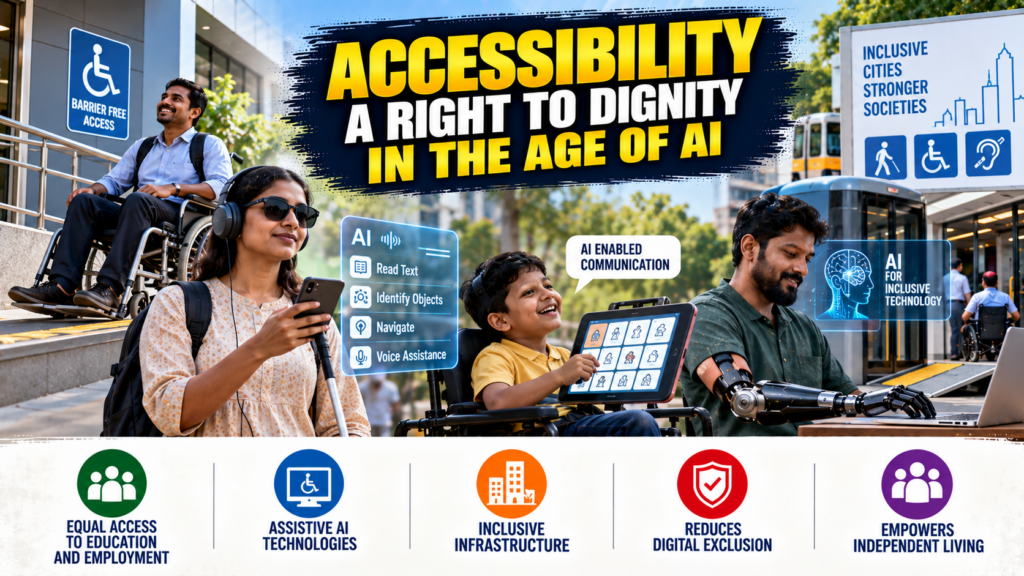
- Computer Vision and Autonomous Navigation: AI tools like Microsoft’s Seeing AI or Google’s Lookout convert visual information into real-time audio, enabling visually impaired individuals to read documents, identify currency notes, and navigate urban spaces independently.
- Assistive AI and Augmentative Communication: Speech-to-Text (STT) and AI-driven voice synthesis allow non-verbal individuals and those with speech impairments to communicate, enter employment, and engage in social dialogue without intermediary dependence.
- Cognitive Accessibility via Generative AI: Large Language Models (LLMs) can simplify complex texts into plain-language summaries, generate visual learning prompts, and tailor interfaces for neurodivergent individuals, directly lowering barriers in education and digital workplaces.
- Neural Interfaces and Advanced Robotics: Brain-Computer Interfaces (BCIs) and smart prosthetics allow individuals with severe motor disabilities (e.g., ALS or spinal cord injuries) to operate computers, robotic limbs, and smartphones via neural signals, restoring physical agency.
Critical Challenges and Technological Gaps
- Algorithmic Bias and Data Exclusion: Most AI models are trained on normative datasets. A 2023 UNESCO report on AI bias highlighted that voice recognition models show significantly higher error rates for non-standard speech patterns (e.g., dysarthria), leading to digital exclusion.
- The Cost and Affordability Barrier: Advanced assistive tech remains financially out of reach for most. According to the WHO-UNICEF Global Report on Assistive Technology (2022), over 90% of people in low- and middle-income countries lack access to the assistive products they need due to high costs and low local production.
- Non-Compliance with Digital Standards: Despite mandatory guidelines, compliance remains abysmal. A 2022 audit by the Centre for Internet and Society (CIS) revealed that a majority of Indian e-governance websites and mobile applications failed to comply even with basic WCAG 2.1 (Web Content Accessibility Guidelines) standards.
- Privacy Risks: PwDs relying on eye-tracking, biometric wearables, or voice monitoring tools generate highly sensitive biological data, leaving them vulnerable to data harvesting and privacy violations without strong legal safeguards.
Way Forward
- Mandating “Accessibility by Design”: Technology developers must integrate WCAG 2.2 accessibility standards at the inception stage of software and hardware development, rather than relying on late-stage retrofitting.
- Inclusive Training Datasets: Developers must intentionally include diverse datasets—encompassing non-normative speech patterns, varied motor movements, and distinct gait signatures—to eliminate algorithmic bias in AI systems.
- Affordable Access via National Missions: The government should leverage initiatives like the Accessible India Campaign (Sugamya Bharat Abhiyan) and targeted subsidies to lower the cost of indigenous assistive technology and smart devices.
|
SOURCE: The Hindu e-paper – Disabled citizens and the future of AI