
|
IN NEWS: Letting the wind flow freely is the secret to cooling our cities
QUESTION: What is terrestrial stilling? Discuss its possible implications for heat stress, evaporation and air-pollution dispersion in rapidly urbanising Indian cities.
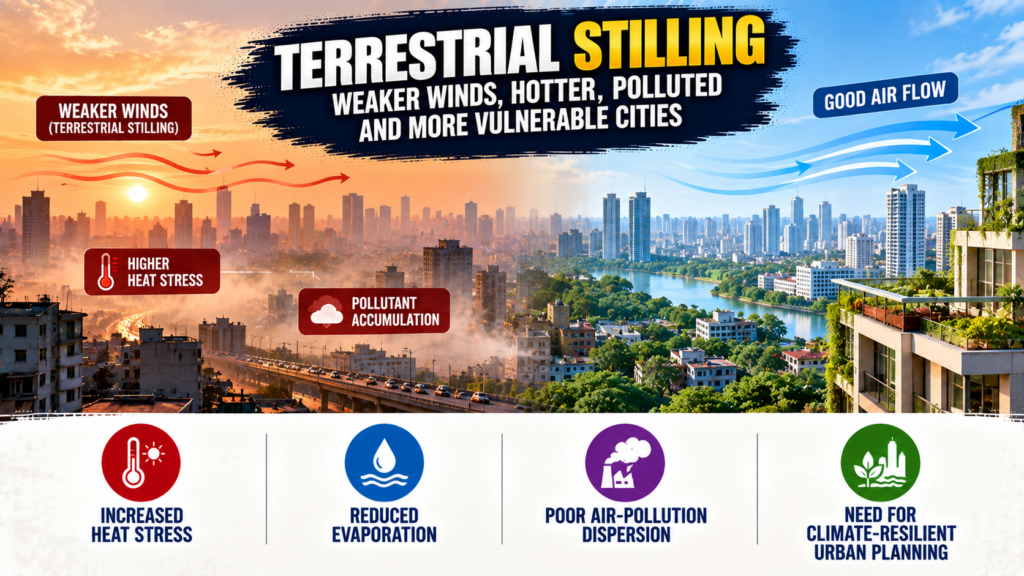
ANSWER: Terrestrial stilling refers to the observed global decline in surface wind speeds over land masses over recent decades. Driven by factors including climate-change-induced shifts in atmospheric circulation and increased land surface roughness—primarily from expanding forest cover and rapid urban infrastructure—this phenomenon significantly alters microclimates, particularly across dense urban environments.
Implications for Heat Stress in Rapidly Urbanising Indian Cities
- Reduction in Evaporative and Convective Cooling:
Lower surface wind speeds diminish the rate of heat exchange between the human body and the surrounding air. In high-humidity tropical and sub-tropical Indian cities (such as Mumbai, Chennai, and Kolkata), reduced wind movement severely hampers sweat evaporation, elevating the perceived temperature and heat index. - Exacerbation of Urban Heat Island (UHI) Effect:
Reduced wind speeds limit the ventilation of trapped heat within dense urban canyons built from concrete and asphalt. This stagnation prolongs high surface temperatures into the night, hindering overnight cooling and increasing the frequency of severe urban heat stress events. - Heightened Public Health Vulnerabilities:
Extended exposure to stagnant, hot air during heatwaves increases heat-related morbidities—such as heat exhaustion and heat stroke—and elevates cardiovascular and respiratory strain, disproportionately affecting outdoor laborers and informal settlement dwellers.
Implications for Evaporation and Hydrological Dynamics
- Decline in Evapotranspiration Rates:
Wind speed is a primary driver of atmospheric water demand. Terrestrial stilling decreases potential evapotranspiration (PET), slowing the removal of moisture from urban water bodies, open soils, and vegetated areas. - Altered Urban Water Balance and Microclimates:
A reduction in evaporation rates alters local humidity profiles and reduces the cooling effect provided by urban wetlands and green spaces. This can disrupt the natural cooling capacity of green-blue infrastructure designed to mitigate urban heat. - Potential Shifts in Precipitation Dynamics:
Slower evaporation rates, combined with altered atmospheric convection at the local scale, can impact localized cloud formation and rainfall patterns, complicating urban storm-water management and local water security.
Implications for Air-Pollution Dispersion
- Accumulation of Surface-Level Pollutants:
Wind acts as the primary natural vector for the transport and dilution of atmospheric pollutants. Stilling leads to atmospheric stagnation, preventing the horizontal dispersion of key pollutants like particulate matter (PM2.5 and PM10), nitrogen oxides (NOx), and sulfur dioxide (SO2). - Severe Winter Smog and Inversion Episodes:
In landlocked Indian cities across the Indo-Gangetic Plain (such as Delhi, Lucknow, and Patna), terrestrial stilling during winter exacerbates thermal inversion layers. The combination of low temperatures, high emissions, and weak surface winds locks hazardous pollutants near the ground, producing prolonged, severe smog episodes. - Increased Formation of Secondary Pollutants:
Stagnant air masses provide extended reaction times for primary emissions in the presence of sunlight, accelerating the formation of secondary pollutants like ground-level ozone (O3) and secondary organic aerosols, which pose severe respiratory hazards.
Wayforward:
- Wind-Sensitive Urban Design: Incorporate ventilation corridors, optimized building heights, and strategic spatial layouts to preserve natural wind paths and enhance urban air flushing.
- Expansion of Blue-Green Infrastructure: Integrate urban forests, green roofs, and interconnected wetlands to promote natural microclimate regulation despite lower ambient wind speeds.
- Targeted Emission Reductions: Strengthen source-level pollution controls under frameworks like the National Clean Air Programme (NCAP) to offset the reduced natural dispersion capacity caused by atmospheric stagnation.
|
SOURCE: The Hindu e-paper – Letting the wind flow freely is the secret to cooling our cities