
|
IN NEWS: What does Trump’s AI accord mean for tech companies?
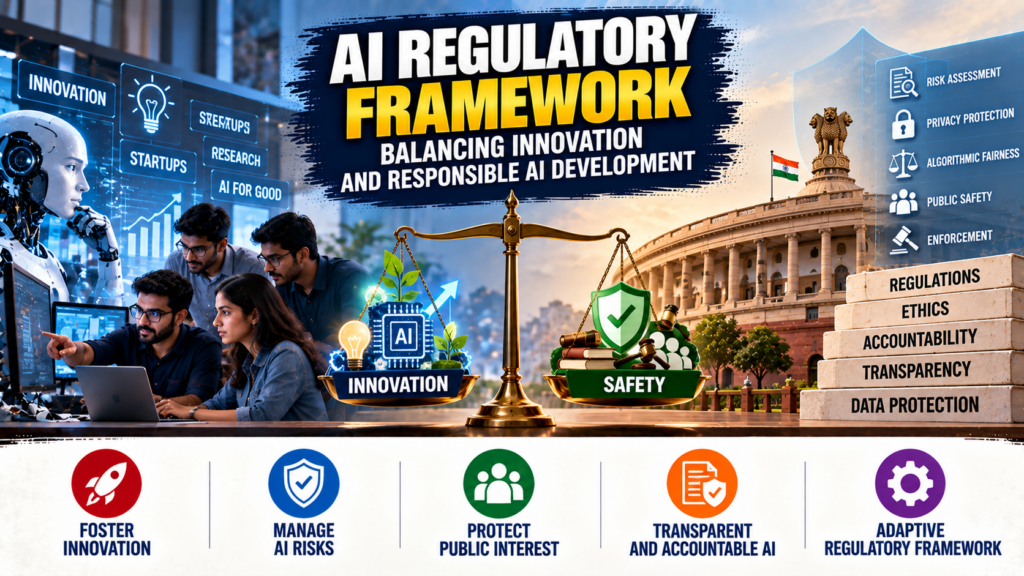
QUESTION: Compare voluntary AI safety commitments with legally enforceable regulatory frameworks. How can a hybrid model of AI governance ensure innovation while minimising technological risks?
ANSWER: Comparative Evaluation: Soft Law vs. Hard Law
1. Voluntary AI Safety Commitments (Soft Law)
- Agility & Adaptive Capacity: Flexible non-binding guidelines (e.g., Hiroshima AI Process, voluntary corporate safety pledges) keep pace with architectural breakthroughs like Large Language Models (LLMs) without suffering from parliamentary delays.
- Pro-Innovation & Low Entry Barriers: Eliminates heavy upfront licensing costs, protecting open-source communities, early-stage startups, and R&D pipelines from immediate regulatory friction.
- Structural Limitations: Lacks statutory force, penal mechanisms, or independent audit requirements. It risks “ethics-washing,” where commercial speed overrides safety considerations without legal consequences.
2. Legally Enforceable Regulatory Frameworks (Hard Law)
- Deterrence & Constitutional Accountability: Imposes binding liabilities, financial penalties, and operational bans (e.g., EU AI Act, mandatory data protection statutes). It codifies non-negotiable protections for user privacy, non-discrimination, and fundamental rights.
- Public Trust & Institutional Legitimacy: Statutory backing creates clear legal remedies and objective compliance standards, strengthening citizen faith in automated state processes.
- Structural Limitations: High compliance overhead costs favor big tech monopolies, creating market entry barriers. Furthermore, static legislative acts suffer from the “pacing problem”—becoming technically obsolete soon after enactment.
Operationalizing the Hybrid Model
A functional hybrid governance architecture decouples core boundary-setting (Hard Law) from dynamic operational standards (Soft Law) through a risk-proportionate, techno-legal framework.
- Tiered Risk Classification:
- Unacceptable Risk (Hard Law): Absolute statutory bans on applications threatening national security or fundamental rights (e.g., autonomous biological weapon design, mass social scoring).
- High Risk (Hard Law): Mandatory third-party conformity audits, algorithmic impact assessments, and strict liability for deployments in critical infrastructure, healthcare, law enforcement, and judicial processing.
- Low / Moderate Risk (Soft Law): Self-certification, voluntary metadata disclosures, and light-touch transparency guidelines for general-purpose algorithms and consumer tools.
- State-Supervised Regulatory Sandboxes: Create controlled live-testing environments allowing developers to deploy frontier models under temporary regulatory waivers. This enables real-time safety monitoring while preserving innovation speed before full commercial release.
- Co-Regulation via Specialized Techno-Legal Bodies: Primary legislation establishes overarching policy principles, while agile administrative bodies—such as specialized AI Safety Institutes—dynamically update technical standards, safety metrics, and red-teaming benchmarks alongside domain experts.
- Embedded Technical Enforcement (Techno-Legal Architecture): Integrate technical compliance safeguards directly into digital ecosystems, including cryptographic watermarking for synthetic media, open auditing protocols, and automated data-lineage tracking aligned with statutory data privacy standards.
A hybrid model of AI governance offers a viable framework to reconcile the tension between technological advancement and systemic risk management.Simultaneously, integrating soft law flexibility through regulatory sandboxes, self-certification, and dynamic technical standards ensures that domestic innovation, open-source development, and startup ecosystems remain unhindered.
|
SOURCE: The Hindu e-paper – What does Trump’s AI accord mean for tech companies?