
SYLLABUS: Environment General Studies – : III Conservation, environmental pollution and degradation, environmental impact assessment.
IN NEWS: India’s river interlinks may create invasive species ‘highways’
QUESTION: How can river interlinking projects facilitate the spread of invasive alien species and aquatic pathogens across geographically isolated river basins? Discuss the potential consequences for freshwater biodiversity in India.
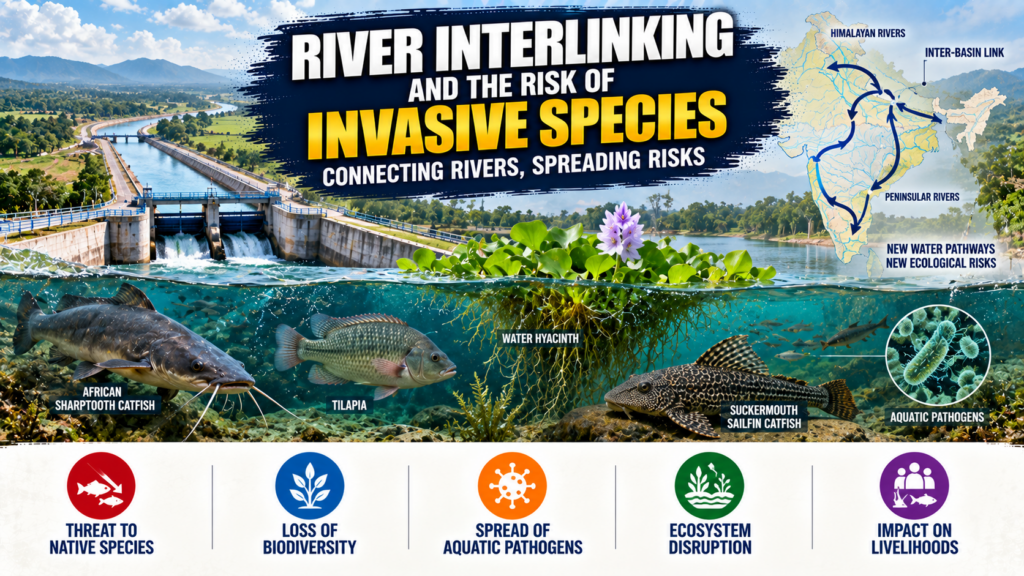
ANSWER: River interlinking projects involve the artificial transfer of large volumes of water across distinct hydrological basins via canals, tunnels, and modified river courses. While intended to address water scarcity and regional imbalance, connecting ecologically isolated river ecosystems creates continuous aquatic corridors. These corridors dissolve natural geographical barriers, providing direct pathways for the transfer of invasive alien species (IAS) and deadly pathogens.
Mechanisms Facilitating the Spread of Invasive Species and Pathogens
- Bypassing Natural Geographical and Ecological Barriers: Historically, river basins acted as isolated biogeographical units separated by watersheds, ridges, and unique water chemistry. Artificial links bypass these barriers, enabling non-native aquatic flora, fauna, and microorganisms to migrate freely into previously unexposed habitats.
- Altering Hydrological and Physicochemical Regimes: Bulk inter-basin water transfer alters temperature, flow velocity, sediment load, and dissolved oxygen levels. These ecological disturbances stress native species while creating favorable, disturbed conditions where adaptable, opportunistic alien species thrive.
- Mass Transport via Water Infrastructure: Canals, reservoirs, and transfer channels act as artificial highways. Planktonic larvae, fish eggs, spores, and microscopic pathogens are passively transported over hundreds of kilometers in high-volume water flows, bypassing local ecological resistance.
- Creation of Reservoir Havens: Interlinking projects rely heavily on storage reservoirs. These static, nutrient-rich, artificial water bodies serve as staging grounds or “stepping stones” where invasive species and pathogens can establish stable populations before colonizing adjacent river stretches.
Potential Consequences for Freshwater Biodiversity in India
- Displacement and Extinction of Endemic Fauna: India’s river basins harbor rich endemic fish species (e.g., in the Western Ghats and Peninsular rivers). Highly aggressive invasive species—such as the African Sharptooth Catfish (Clarias gariepinus), Tilapia (Oreochromis niloticus), and Suckermouth Sailfin Catfish (Pterygoplichthys)—outcompete, prey upon, and gradually hybridize with native fish, driving endemic populations toward local extinction.
- Outbreaks of Aquatic Pathogens and Mass Mortality: Isolated river populations lack acquired immunity against foreign pathogens. Interlinking can facilitate the spread of fungal infections (like Epizootic Ulcerative Syndrome), viral diseases, and parasites across basins, triggering severe disease outbreaks and mass die-offs among indigenous fish and amphibian populations.
- Proliferation of Invasive Aquatic Flora: Floating and submerged weed species—such as Water Hyacinth (Eichhornia crassipes) and Water Lettuce (Pistia stratiotes)—spread rapidly through transfer canals. They form dense surface mats, blocking sunlight, depleting dissolved oxygen, and suffocating native aquatic flora and benthic organisms.
- Homogenization of Freshwater Ecosystems: As invasive generalists establish dominance across connected basins, distinct regional aquatic communities lose their unique species composition. This process of “biotic homogenization” reduces overall genetic diversity and diminishes the resilience of Indian river systems to climate change and human stressors.
- Disruption of Food Webs and Eco-Services: The decline of native keystone species alters nutrient cycling, disrupts predator-prey dynamics, and destabilizes food webs. This ecological damage cascades into socioeconomic losses, severely impacting the livelihoods of inland fishing communities reliant on indigenous riverine catches.
Wayforward
- Rigorous Environmental Impact Assessments (EIA): Conduct comprehensive bio-risk assessments and ecological modeling prior to approving inter-basin water transfer links.
- Biosecurity and Barrier Protocols: Implement mechanical screening, acoustic barriers, or physical control measures along transfer channels to limit the migration of invasive organisms and fish larvae.
- Integrated Basin Management: Shift toward basin-level ecological restoration, emphasizing local rainwater harvesting and watershed management to minimize the need for large-scale interlinking.
- Continuous Ecological Monitoring: Establish real-time eDNA (environmental DNA) surveillance networks across interconnected rivers for early detection of invasive species and pathogen vectors.
PYQ REFERENCE UPSC 2020 Q. “How does the biodiversity of an area get affected by the introduction of an invasive alien species? Mention the methods to prevent such an introduction.”
SOURCE: The Hindu epaper – India’s river interlinks may create invasive species ‘highways’