
|
IN NEWS: How to finance rural prosperity
QUESTION: “India’s first agricultural transformation delivered food security, while the next agricultural transformation must deliver rural prosperity.” Discuss the structural changes required to shift Indian agriculture from production-centric growth to value-chain-led growth.(250 words)
ANSWER: Here is an updated, high-density Mains answer incorporating concrete economic metrics, government schemes, and targeted agricultural policy terminology, strictly formatted without tables or flowcharts.
Introduction
India’s Agriculture 1.0 achieved national food self-sufficiency, scaling foodgrain production to ~330 Million Metric Tonnes (MMT). However, with 54.6% of the workforce employed in agriculture contributing only ~16–18% to Gross Value Added (GVA), Agriculture 2.0 must shift focus toward income resilience and rural prosperity. Achieving this requires transitioning from a production-centric model to an integrated, value-chain-led agribusiness framework.
Shift in Paradigm: Production vs. Value-Chain Growth
- Production-Centric Framework: Focused on volume expansion of wheat and paddy via resource-intensive input subsidies (power, fertilizer, water) and Minimum Support Price (MSP) procurement. This led to eco-degradation, ground-water depletion (e.g., Punjab-Haryana belt), monoculture, and depressed farm-gate realizations.
- Value-Chain-Led Framework: Prioritizes post-harvest value addition, market integration, and net realization per unit of land/water. It reorients policy from yield per hectare to Net Agricultural Value Added (NVA) across the entire supply chain.
Core Structural Reforms Required
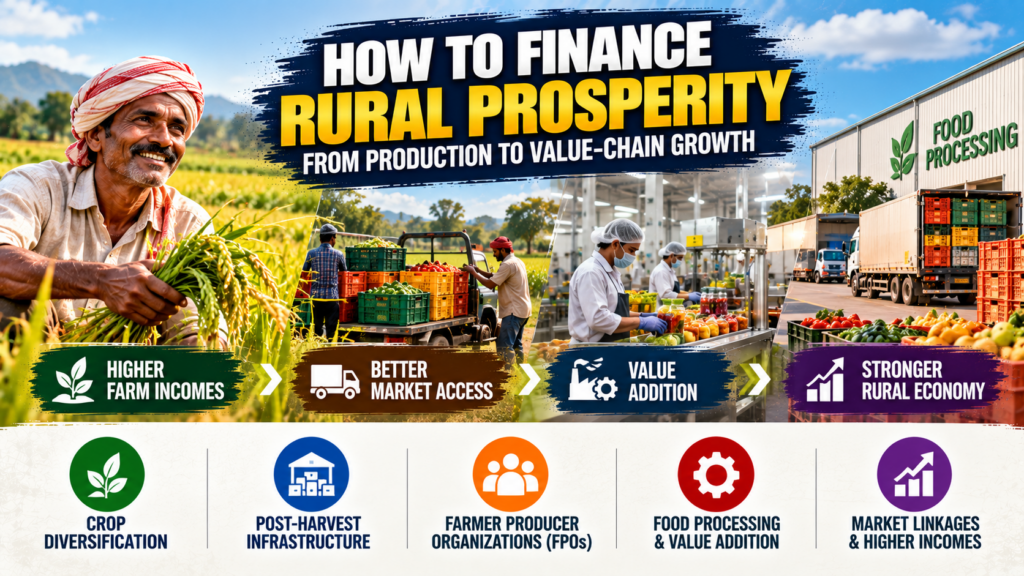
1. Crop Diversification & Demand-Driven Production
- High-Value Agriculture (HVA): Incentivize structural shifts toward horticulture, pulses, oilseeds, livestock, and dairying, which account for >50% of agricultural output value and exhibit high income elasticity.
- Targeted Missions: Expand the National Mission on Edible Oils – Oil Palm (NMEO-OP) and Sub-Mission on Seeds and Planting Material (SMSP) to optimize crop geometry away from water-intensive cereals.
2. Post-Harvest Infrastructure & Secondary Agriculture
- Infrastructure Augmentation: Address post-harvest losses (estimated at ₹92,600 crore annually) by operationalizing the ₹1 Lakh Crore Agriculture Infrastructure Fund (AIF) for decentralized cold chains, sorting, and grading units.
- Processing Ecosystem: Leverage the Pradhan Mantri Kisan SAMPADA Yojana (PMKSY) and PM Formalisation of Micro Food Processing Enterprises (PMFME) scheme to boost food processing levels from ~10% to international standards (>30%).
3. Institutional Aggregation & Scale Economies
- Scale Optimization via FPOs: Operationalize 10,000 Farmer Producer Organizations (FPOs) to aggregate smallholders (86% operating <2 hectares) for collective bargaining in input procurement and output monetization.
- Institutional Frameworks: Implement the Model Agricultural Land Leasing Act to enable legal land pooling without title transfer risks, encouraging long-term private capital investment.
4. Market Modernization & Direct Commercialization
- De-risking APMC Regulation: Modernize state APMC Acts to allow private markets, direct farm-gate procurement, and contract farming under the Model Contract Farming Act.
- Digital Price Discovery: Integrate physical mandis with the e-NAM (Electronic National Agriculture Market) platform and leverage AgriStack (Unified Farmer Service Platform) for transparent price discovery and reduced trade intermediation margins.
5. Agri-Tech Deployment & Climate Resilience
- Precision Farming: Deploy Sub-Mission on Agricultural Mechanization (SMAM) and drone technology for precision input delivery, reducing cost of cultivation.
- De-risking Credit: Transition from asset-backed lending to cash-flow-based underwriting using digital land records and satellite data, backed by Pradhan Mantri Fasal Bima Yojana (PMFBY) for yield risk mitigation.
Socio-Economic Impact
- Farm Income Growth: Post-harvest processing and direct market linkages improve the farmer’s share in the end-consumer rupee.
- Off-Farm Employment: Secondary agriculture and logistics nodes absorb surplus rural labor, mitigating disguised unemployment.
- Resource Sustainability: Shifting to diversified cropping patterns mitigates groundwater extraction and soil degradation.
Transforming Indian agriculture requires aligning policy incentives under the AIF, PMKSY, and e-NAM to transition farmers from crop producers to commercial agribusiness managers, delivering sustainable rural prosperity.
|
SOURCE: The Hindu, epaper – How to finance rural prosperity