
SYLLABUS: Indian Polity General Studies – : II Appointment to various Constitutional posts, powers, functions and responsibilities of various Constitutional Bodies.
IN NEWS: In need of an overhaul
QUESTION: “Electoral-roll management requires both accuracy of voter lists and procedural fairness in inclusion and deletion.” Discuss
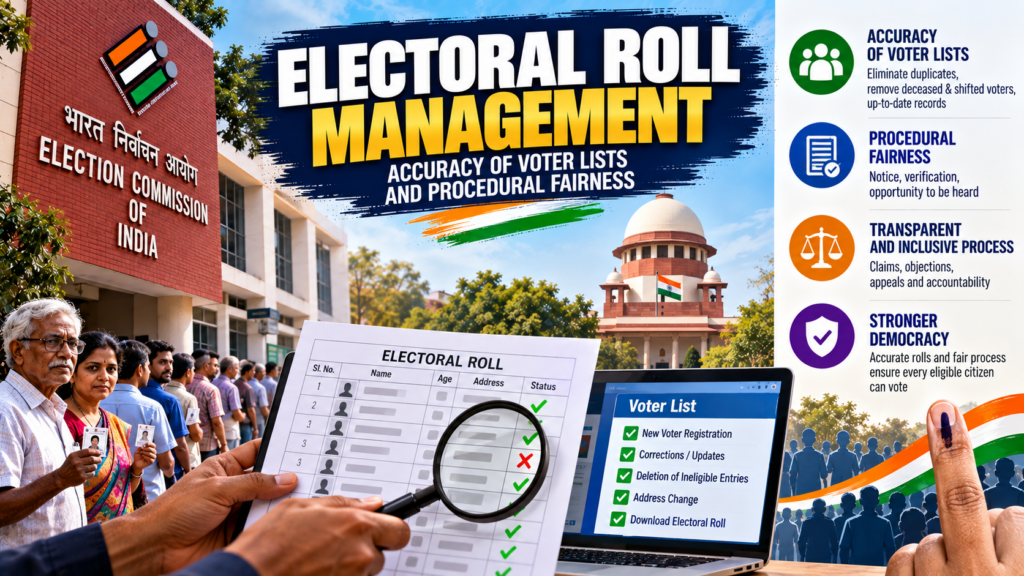
ANSWER: Efficient electoral-roll management forms the foundation of free and fair elections in any constitutional democracy. It balances administrative precision (accuracy) with constitutional rights and natural justice (procedural fairness) to prevent both disenfranchisement and electoral fraud.
1. Accuracy of Voter Lists: Dimensions & Challenges
- Elimination of Duplications: Migration across administrative boundaries often leads to double registration. Continuous deduplication via demographic software, combined with field verification by Booth Level Officers (BLOs), helps keep entries unique.
- Removal of Deceased and Shifted Electors: Retaining names of deceased or relocated voters creates vulnerabilities for impersonation. Integrating civil registration systems (birth and death registries) with electoral database management systems provides automatic flags for potential purges.
- Precision in Spatial Mapping: Misallocation of voters to incorrect polling stations causes confusion on polling day. GIS mapping and door-to-door verification map voter residences accurately to defined polling station boundaries.
2. Procedural Fairness: Safeguarding Voter Rights
- Principles of Natural Justice (Audi Alteram Partem): Before deleting any name from the roll, the Electoral Registration Officer (ERO) must issue formal notice, providing adequate time for the affected individual to respond or present proof of eligibility.
- Transparent Inclusion and Objection Processes: Public exhibition of draft electoral rolls enables citizens and political parties to file claims for inclusion or raise objections against wrongful entries using standard statutory forms.
- Safeguards Against Mass or Suo Motu Deletions: Bulk deletions carried out without individual notice or verification violate natural justice. Mandatory field inspections and written, reasoned orders by the ERO serve as essential checks against mass arbitrary purges.
- Robust Appellate Architecture: Provision for a clear, multi-tiered appeal hierarchy—moving from the ERO to the District Election Officer (DEO) and subsequently to the Chief Electoral Officer (CEO)—ensures institutional accountability.
3. Tension Between Accuracy and Procedural Fairness
- Risk of Over-Emphasizing Accuracy: An aggressive focus on purging invalid names through automated algorithms can cause accidental bulk removals of legitimate voters, particularly vulnerable, migrant, or marginal populations. This requires mandatory manual field verification before any deletion order is finalized.
- Risk of Over-Emphasizing Procedural Formalities: Strict or lengthy procedural requirements without strict timelines can delay necessary updates, leaving outdated or duplicate entries on the roll when elections arrive. Establishing time-bound statutory disposal windows for claims and objections mitigates this issue.
WayForward
- Continuous Updating: Moving beyond periodic revision drives toward a continuous revision model ensures rolls dynamically capture demographic shifts without creating administrative bottlenecks right before polling.
- Hybrid Verification Framework: Technological tools should serve only to generate preliminary alerts for duplicate or invalid records, while final decisions remain dependent on physical verification by field staff.
- Multi-Stakeholder Participation: Involving Booth Level Agents (BLAs) appointed by recognized political parties creates shared oversight, increasing overall public trust in the integrity of the published rolls.
PYQ REFERENCE UPSC 2020 “In the light of recent controversy regarding the use of Electronic Voting Machines (EVMs), discuss the challenge to the Election Commission of India to maintain the credibility of the electoral process.”