
SYLLABUS: Environment General Studies – : III Conservation, environmental pollution and degradation, environmental impact assessment.
IN NEWS: What is Karnataka’s objection to the ESA?
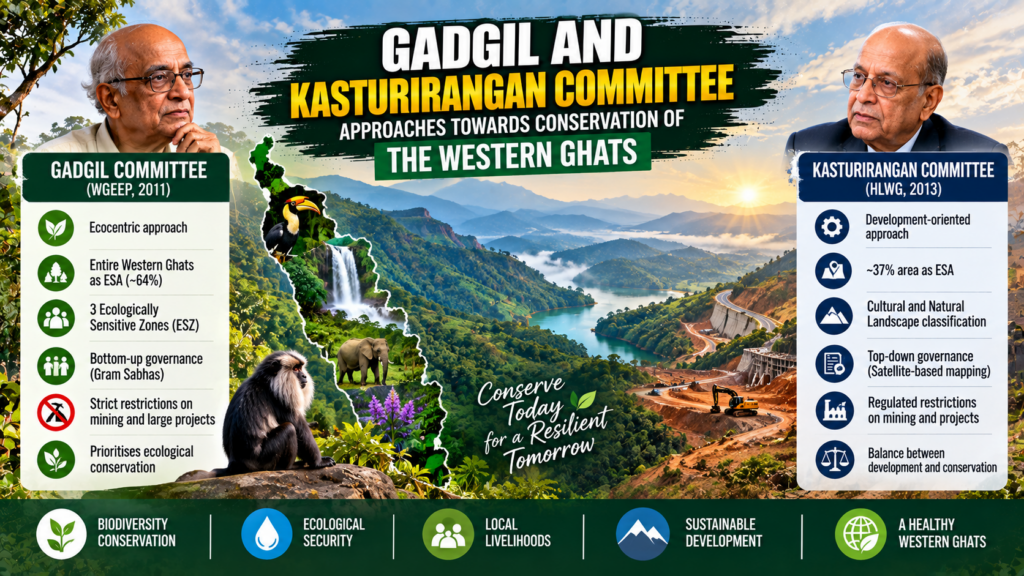
QUESTION: Compare the approaches of the Gadgil Committee and Kasturirangan Committee towards conservation of the Western Ghats.
ANSWER: The Western Ghats, a UNESCO World Heritage site and global biodiversity hotspot, represent the ecological backbone of peninsular India. To conserve this fragile landscape, the Ministry of Environment, Forest and Climate Change (MoEFCC) constituted two prominent panels: the Western Ghats Ecology Expert Panel (WGEEP) headed by Madhav Gadgil (2011) and the High-Level Working Group (HLWG) chaired by K. Kasturirangan (2013).
Comparative Analysis: Gadgil Committee vs. Kasturirangan Committee
| Parameter | Gadgil Committee (WGEEP, 2011) | Kasturirangan Committee (HLWG, 2013) |
| Philosophical Approach | Ecentric / Ecocentric: Prioritizes ecological integrity over economic expansion; views conservation as an overarching imperative. | Anthropocentric / Development-Oriented: Aims for a “sustainable development” balance between ecology and economic growth. |
| Coverage & ESA Demarcation | Declared the entire Western Ghats range (~1,29,037 sq km or ~64% of the region) as an Ecologically Sensitive Area (ESA). | Reduced the ESA footprint significantly, designating only ~37% (56,825 sq km) as ecologically sensitive. |
| Zonation & Landscape Classification | Classified the region into three Ecologically Sensitive Zones (ESZ 1, 2, and 3) based on ecological fragility, enforcing graded regulations. | Classified the Western Ghats into Cultural Landscapes (human settlements, agriculture, plantations—58%) and Natural Landscapes (forested—42%). |
| Governance Architecture | Bottom-Up & Decentralized: Advocated strong local governance by empowering Gram Sabhas and local bodies under the 73rd and 74th Constitutional Amendments. | Top-Down & Bureaucratic: Relied on state administration, regulatory bodies, and expert-driven machinery rather than local Gram Sabhas. |
| Methodology for Assessment | Combined field-level ecological inputs, historical data, and extensive consultations with local communities. | Used high-resolution remote sensing, satellite imagery, and spatial technologies to map natural vegetation continuous bands. |
| Stance on Specific Sectors | Mining & Power: Total ban on mining and large hydro projects in ESZ-1; phased exit of existing mining leases. Agriculture: Mandatory shift away from chemical pesticides and GM crops. | Mining & Power: Complete ban on mining, quarrying, and red-category industries in ESA; allowed hydro projects after strict EIA. Agriculture: Excluded agriculture and plantations from ESA restrictions. |
| Institutional Mechanism | Recommended establishing a statutory Western Ghats Ecology Authority (WGEA) under the Environment (Protection) Act, 1986. | Opposed creating new statutory authorities; advocated strengthening existing state-level environmental monitoring bodies. |
Core Reasons for the Divergence in Approaches
- Environmental Idealism vs. Pragmatic Governance:
- Gadgil took a holistic landscape approach, treating the Western Ghats as an unbroken, interconnected ecological entity.
- Kasturirangan sought a pragmatic compromise, arguing that complete restrictions over populated areas were politically unfeasible and socially disruptive.
- Federal and Political Pushback:
- The Gadgil report faced severe resistance from state governments (e.g., Kerala, Karnataka, Maharashtra) and local communities who feared loss of livelihoods, land acquisition issues, and curbs on cash-crop farming.
- The Kasturirangan Committee was explicitly set up as a “High-Level Working Group” to dilute the Gadgil report into a politically acceptable document.
- Technocratic vs. Participatory Mapping:
- The WGEEP relied heavily on democratic decentralization, aiming to let local communities decide development limits.
- HLWG prioritized scientific satellite data to physically separate forests from habitations, leading to complaints of ground-level errors where agricultural lands were inadvertently classified as forests.
Way Forward
- The Dilemma: Gadgil’s recommendations were scientifically robust and visionary, but lacked political feasibility. Kasturirangan’s model offered practical implementability, but fragmented ecological corridors by leaving 63% of the region open to intense commercial activities.
- Consequences of Delay: Recurrent landslides, flash floods, and ecological disasters in Western Ghat states (e.g., Wayanad, Idukki, Uttara Kannada) underscore the cost of failing to finalize an ESA notification due to political deadlocks.
A middle-ground framework is necessary—one that incorporates Gadgil’s emphasis on community-led Gram Sabha participation and Kasturirangan’s spatial mapping technology. Finalizing the Ecologically Sensitive Area notification with state consensus, enforcing climate-resilient land-use policies, and building sustainable livelihood alternatives for local populations are essential to preserving the Western Ghats.
|
SOURCE: The Hindu e-paper – What is Karnataka’s objection to the ESA?