
|
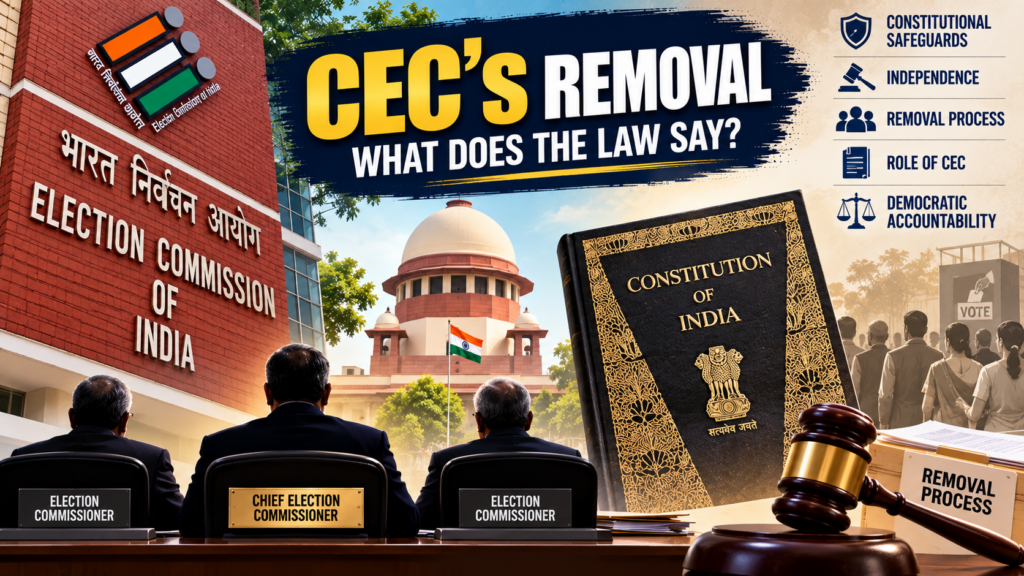
IN NEWS: What does the law say about CEC’s removal?
QUESTION: Compare the constitutional safeguards available to the Chief Election Commissioner and the other Election Commissioners against removal. Why has the Constitution adopted an asymmetrical protection mechanism? (10 marks, 150 words)
ANSWER: The Election Commission of India (ECI), constituted under Article 324 of the Constitution, is tasked with ensuring free, fair, and impartial elections. To insulate the election machinery from political interference, the framers embedded specific security-of-tenure protections within Article 324(5). However, these protections differ significantly between the Chief Election Commissioner (CEC) and the other Election Commissioners (ECs).
Comparison of Constitutional Safeguards Against Removal
The constitutional mechanics governing removal highlight stark structural differences:
| Parameter | Chief Election Commissioner (CEC) | Other Election Commissioners (ECs) |
| Constitutional Basis | Article 324(5), First Proviso | Article 324(5), Second Proviso |
| Grounds for Removal | Proved misbehaviour or incapacity (benchmarked to a Judge of the Supreme Court under Article 124(4)). | No explicit constitutional grounds specified. However, courts require “intelligible and cogent considerations”. |
| Removal Mechanism | Requires an order passed by the President following a parliamentary address by a special majority in both Houses (under the Judges (Inquiry) Act, 1968). | Removed directly by the President only on the recommendation of the CEC. No parliamentary vote is required. |
| Role of Executive | High insulation; the Union Council of Ministers cannot directly advise or initiate removal without parliamentary proceedings. | Indirect insulation; while the executive cannot directly dismiss an EC at will, protection depends on the CEC’s recommendation. |
| Equality in Status vs. Safeguard | Enjoys both salary/status parity and explicit constitutional removal protection equal to an SC Judge. | Enjoys salary/status parity, but lacks equal direct constitutional protection against removal. |
Rationale Behind the Asymmetrical Protection Mechanism
1. Constituent Assembly’s Intent and Structural Flexibility
- Optional Multi-Member Design: Article 324(2) states that the ECI shall consist of the CEC and “such number of other Election Commissioners, if any, as the President may from time to time fix”.
- Variable Strength: The Constituent Assembly intended for the CEC to be a permanent constitutional anchor. Other Election Commissioners were conceived as temporary or seasonal additions to handle surge workloads during general elections, rather than permanent fixtures. Providing rigid, impeachment-like protection to temporary members was seen as impractical.
2. Institutional Primacy and Internal Discipline
- Preventing Deadlock: As held in T.N. Seshan v. Union of India (1995), the safeguard provided to ECs (requiring the CEC’s recommendation for removal) is designed to act as a shield against political victimisation by the executive while enabling the ECI to maintain internal order.
- Protecting ECs from Executive Interference: Requiring the CEC’s concurrence ensures that the ruling executive cannot unilaterally dismiss an independent EC who takes an unfavorable decision. The CEC serves as a constitutional buffer between the executive and the ECs.
3. Judicial Interpretation on “Recommendation”
- In T.N. Seshan (1995), the Supreme Court clarified that the power of the CEC to recommend the removal of an EC is not arbitrary or absolute. The recommendation must be based on intelligible, cogent, and relevant considerations related to the efficient functioning of the Commission. This ensures that the CEC cannot abuse this power to suppress dissenting ECs.
Critical Concerns and Judicial Observations
- Equivalence in Decision-Making vs. Unequal Protection: Since the Election Commission (Conditions of Service of Election Commissioners and Transaction of Business) Act, 1991 (retained in the 2023 Act), decisions within the multi-member ECI are taken either unanimously or by majority vote. The CEC holds no veto over ECs. Critics point out that having equal voting power without equal security of tenure creates a structural anomaly.
- Supreme Court Observations (Anoop Baranwal v. Union of India, 2023): The Constitution Bench highlighted that to preserve complete institutional independence, equal protection across all members of the ECI is desirable. Lacking equal protection leaves ECs potentially vulnerable to subtle political pressure if they harbor aspirations for promotion to the post of CEC.
The original asymmetrical protection was designed for an operational model where the ECI was primarily a single-member body supported temporarily by additional commissioners. Today, with the ECI functioning as a permanent multi-member body where decisions are taken by majority, extending equal removal safeguards to all Election Commissioners—as recommended by various Law Commission reports (e.g., 255th Report)—remains vital to strengthening overall electoral autonomy.
|
SOURCE: The Hindu e-paper – What does the law say about CEC’s removal?