
| SYLLABUS: Economy General Studies:- III Indian Economy and issues relating to Growth, Development. |
IN NEWS: Quality control and India’s manufacturing growth
QUESTION: “Quality Control Orders can improve the quality of Indian manufacturing, but may also increase compliance costs for MSMEs.” Discuss. (15 Marks, 250 Words)
ANSWER: Quality Control Orders (QCOs) make compliance with specified Bureau of Indian Standards (BIS) standards mandatory for notified products, covering both domestic production and imports. They aim to improve product quality, consumer safety, standardisation and the global competitiveness of Indian manufacturing. However, their rapid expansion has raised concerns regarding compliance costs, input availability and supply-chain disruptions.
How are QCOs strengthening Indian manufacturing?
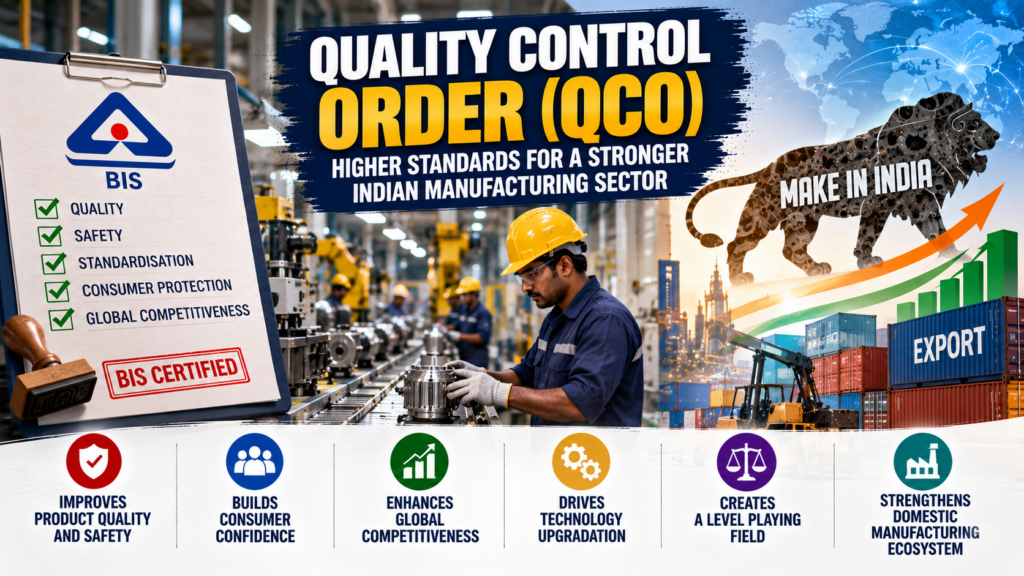
- Improve product quality: Mandatory standards can reduce sub-standard products and enhance consumer safety and reliability.
Example: Toys – BIS certification made mandatory. - Build consumer confidence: Standardisation and certification can strengthen the credibility of Made in India products.
Example: Gold jewellery – mandatory BIS hallmarking. - Global competitiveness: Harmonisation with international standards can help Indian firms meet quality requirements in export markets.
Example: 93.3% of corresponding Indian Standards harmonised with ISO (International Organization for Standardization) /IEC (International Electrotechnical Commission) standards. - Technology upgradation: Compliance can incentivise firms to modernise production processes, testing facilities and quality-management systems.
Example: Solar PV – QCO covers modules, inverters and storage batteries. - Level playing field: Applying standards to both domestic and imported products can prevent competition based purely on cheaper, lower-quality products.
Example: Steel – QCO requirements apply to specified imported and domestically produced steel products. - Domestic manufacturing ecosystem: QCOs can encourage development of domestic capabilities in products where India has the potential to build competitive supply chains.
Example: Footwear – BIS certification mandated for 24 categories.
Thus, the government has explicitly linked QCOs with creating a stronger quality ecosystem and improving the global reputation of Indian manufacturing.
Concerns of QCO on MSME’s:
- High compliance burden
- Certification, testing, factory inspection and licence-renewal costs can be significant for firms operating on thin margins.
- MSMEs often lack in-house testing infrastructure and technical personnel.
- QCOs on intermediate goods
- A major concern is that QCOs increasingly cover raw materials and intermediate inputs, rather than only finished products.
- This can restrict access to specialised inputs where domestic substitutes are unavailable or inadequate.
- Supply-chain disruptions
- Mandatory certification of imported inputs can result in delays at ports, longer procurement cycles and production bottlenecks.
- This is particularly problematic for industries integrated into global value chains.
- Higher input costs and reduced competitiveness
- Restricted sourcing can force firms to purchase costlier domestic alternatives.
- Costs may ultimately be passed on to consumers through higher prices.
- Risk of market concentration
- Large firms can absorb certification and compliance costs more easily.
- Smaller firms may exit or lose market share, potentially reducing competition and increasing concentration.
- Export competitiveness
- If Indian manufacturers face higher input costs while competing with firms in countries such as Vietnam or Bangladesh, QCOs on intermediate goods can weaken price competitiveness in export markets.
Way forward: From blanket regulation to risk-based regulation
Though the government has already introduced some corrective measures, including additional compliance time for micro and small enterprises, concessions in BIS marking fees and greater flexibility regarding testing infrastructure additionally following measures can be implemented:
Risk-based QCOs: Prioritise products involving health, safety and environmental risks rather than applying mandatory certification indiscriminately.
Differentiate finished goods and intermediate inputs: Avoid restricting critical inputs where adequate domestic alternatives are unavailable.
Phased implementation: Provide longer transition periods for MSMEs and legacy-stock clearances.
Strengthen testing infrastructure: Expand accredited laboratories and reduce testing backlogs.
Simplify certification: Digital, time-bound and transparent BIS procedures with differentiated requirements based on firm/product risk.
MSME support: Provide financial and technical assistance for certification, testing and technology upgradation.
International harmonisation: Align Indian standards wherever appropriate with internationally accepted standards to facilitate GVC integration.
Periodic review: Assess QCOs on the basis of their impact on quality, prices, production, imports, exports and MSME competitiveness.
QCOs should raise India’s quality standards without becoming a barrier to manufacturing scale. The Transition Facilitation (Quality Control) Order, 2026, through its risk-based compliance mechanism, reflects this balance; complemented by MSME support, quality assurance and uninterrupted access to critical inputs, it can enable India to achieve both competitive manufacturing and deeper integration into global value chains.
|
SOURCE: The Hindu e-paper – Quality control and India’s manufacturing growth