
|
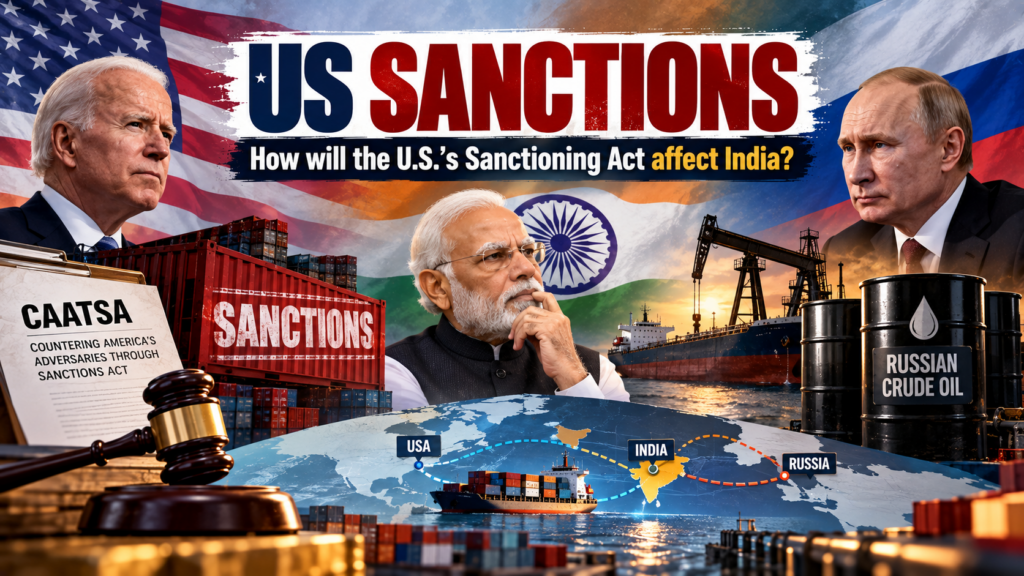
IN NEWS: How will the U.S.’s Sanctioning Act affect India?
QUESTION: How can the U.S. sanctions regime against Russia affect India’s relations with both the United States and Russia? Discuss the challenges for India in maintaining strategic balance.
ANSWER: The U.S.-led Western sanctions regime against Russia—amplified by sweeping legislative tools such as the Countering America’s Adversaries Through Sanctions Act (CAATSA) and targeted energy trade restrictions—poses a complex foreign policy dilemma for India. India’s grand strategy relies on “multi-alignment,” maintaining a Comprehensive Global Strategic Partnership with the U.S. while safeguarding its Special and Privileged Strategic Partnership with Russia.
Impact on India’s Relations with the United States
- Friction Over Energy Purchases: India’s increased procurement of discounted Russian crude oil to protect domestic inflation and energy security has drawn persistent scrutiny from Washington. Unilateral U.S. sanctions targeting Russian energy supply chains and secondary buyers create recurring friction points in bilateral trade discussions.
- Divergence on Global Governance & Multilateralism: Washington views economic sanctions as a legitimate tool to enforce rules-based order, whereas New Delhi rejects unilateral sanctions not sanctioned by the United Nations, arguing they violate sovereign trade choices.
- Threat of Secondary Sanctions: The potential application of secondary sanctions or punitive tariffs on third-party trade creates operational uncertainty for Indian businesses, banks, and public-sector enterprises engaged in dual-currency transactions with Russian firms.
- Shared Strategic Interests as a Stabilizer: Despite tactical disagreements over Russia, the broader U.S.-India partnership remains grounded in convergence across the Indo-Pacific (via the Quad), defense technology sharing (iCET), and balancing China’s assertive rise.
Impact on India’s Relations with Russia
- Strengthening Economic and Energy Cooperation: Western sanctions forced Moscow to reorient its trade toward Asia. India’s continued absorption of Russian crude transformed the trade profile, boosting bilateral trade toward multi-decade highs.
- Disruption in Defense Supply Chains: Russia remains India’s largest defense equipment supplier. Sanctions on Russian defense entities (such as Rosoboronexport) disrupt spare parts deliveries, servicing schedules, and payments for critical hardware like the S-400 Triumf system and stealth frigates.
- Payment Mechanism Complications: International messaging systems (like SWIFT) bans on major Russian banks forced India and Russia to explore alternative non-dollar payment systems (Rupee-Rouble mechanisms and local currency settlements), though currency convertibility and trade imbalances pose ongoing challenges.
- Geopolitical Realignment Risks: India remains concerned that prolonged Western isolation will force Russia into a tighter, asymmetric strategic embrace with China, potentially weakening Moscow’s traditional role as an independent balancing force in Eurasia.
Challenges for India in Maintaining Strategic Balance
- Navigating Defense Dependency vs. Western Integration: India cannot rapidly decouple from Russian defense platforms without creating critical operational vulnerabilities along its contested borders with China and Pakistan. Concurrently, building high-tech defense co-development with the U.S. requires proving long-term alignment.
- Managing Currency and Payment Bottlenecks: Navigating global sanctions requires bypassing financial channels. However, Indian banks with exposure to the U.S. financial system are hesitant to clear transactions involving sanctioned Russian entities due to over-compliance and fear of secondary penalties.
- Balancing Continental and Maritime Security: India relies on Russia to maintain stability across continental Eurasia and Central Asia, while relying on the U.S. and Quad partners for maritime security in the Indo-Pacific.
- Preserving Autonomy in Global Forums: Maintaining strategic autonomy requires avoiding taking sides in voting resolutions against Russia at the UN, while simultaneously emphasizing respect for territorial integrity, sovereignty, and international law.
The U.S. sanctions regime forces India to manage a delicate diplomatic balance. India’s response emphasizes pragmatic self-interest—securing affordable energy for domestic growth, diversifying defense sourcing, and pursuing localized trade clearing—while remaining a vital Indo-Pacific partner to the West. Maintaining strategic balance requires continuous diplomatic engagement with Washington to secure sanction waivers or flexibility, combined with clear boundary-setting with Moscow to ensure its global realignments do not undermine India’s core security interests
|
SOURCE: The Hindu e-paper – How will the U.S.’s Sanctioning Act affect India?