
|
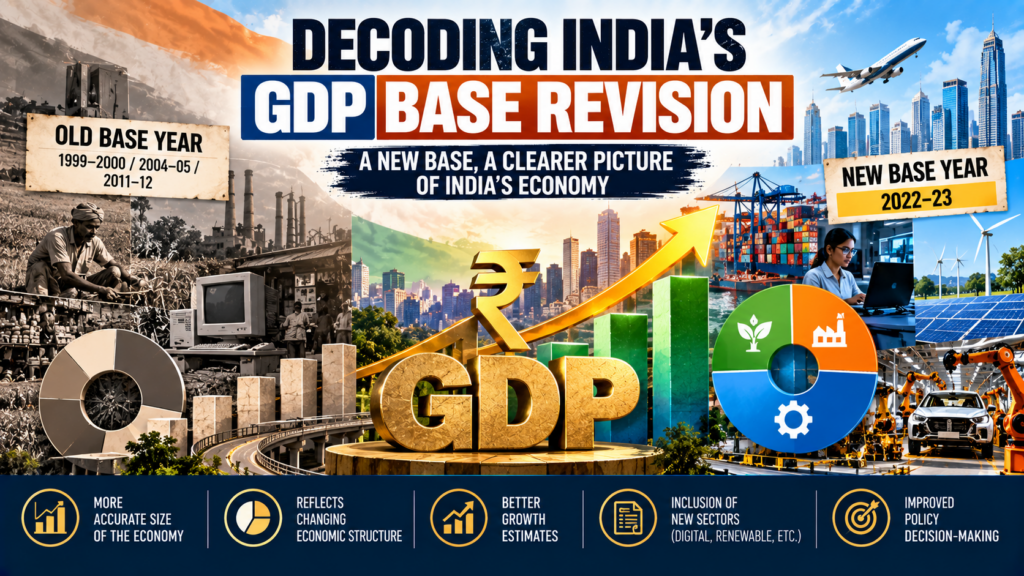
IN NEWS: Decoding India’s GDP base revision
QUESTION: What is meant by GDP rebasing? Explain its significance in measuring the size, structure and growth of the Indian economy.
ANSWER: GDP rebasing refers to the periodic updating of the benchmark year (base year) used to calculate Real Gross Domestic Product. It involves updating the price structure, data sources, weighting schemes, and methodology to ensure that national accounts accurately reflect structural changes, technological advancements, and shifting consumption patterns in the economy over time.
Significance of GDP Rebasing in Measuring the Indian Economy
- Measuring the Size of the Economy
- Inclusion of Uncounted Economic Activity: Rebasing integrates newly emerging sectors—such as the digital economy, start-ups, and renewable energy—that were either absent or underestimated in the old base year, leading to a more accurate representation of total output.
- Broader Coverage of Informal and Formal Data: Updated administrative databases (such as MCA-21 corporate data, GST network records, and informal sector surveys) expand data coverage, typically resulting in an upward revision of nominal GDP size.
- International Comparability: Rebased GDP ensures alignment with global standards like the UN System of National Accounts (SNA), improving global confidence in India’s macroeconomic indicators and credit ratings.
- Measuring the Structure of the Economy
- Reflecting Sectoral Shifts: Over time, the relative contribution of agriculture, manufacturing, and services changes. Rebasing adjusts sectoral weights so that fast-growing sectors (e.g., IT, fintech, modern services) carry appropriate weight compared to declining sectors.
- Updating Price Relatives: It replaces outdated base prices with newer prices, removing distortion caused by outdated price structures and improving the accuracy of GDP deflators.
- Capturing Evolving Consumer Patterns: It updates the basket of goods and services to include modern consumption trends, such as increased expenditure on healthcare, education, and digital services.
- Measuring Economic Growth
- Elimination of Base Effect Distortions: An older base year can distort annual growth rates due to outdated weighting. Rebasing provides a realistic growth trajectory for real GDP.
- Improved Policy Formulation: Accurate real growth estimates allow the Ministry of Finance, the Reserve Bank of India, and policymakers to design targeted monetary and fiscal policies based on actual demand and supply conditions.
- Better Estimation of Key Ratios: Rebased GDP alters critical macroeconomic ratios—such as Fiscal Deficit-to-GDP, Tax-to-GDP, and Debt-to-GDP—giving a realistic picture of fiscal health and sustainability.
GDP rebasing is essential for ensuring that national income statistics remain statistically robust, structurally representative, and reflective of India’s changing economic reality.
|
SOURCE: The Hindu e-paper – Decoding India’s GDP base revision