
|
IN NEWS: Falling edifice
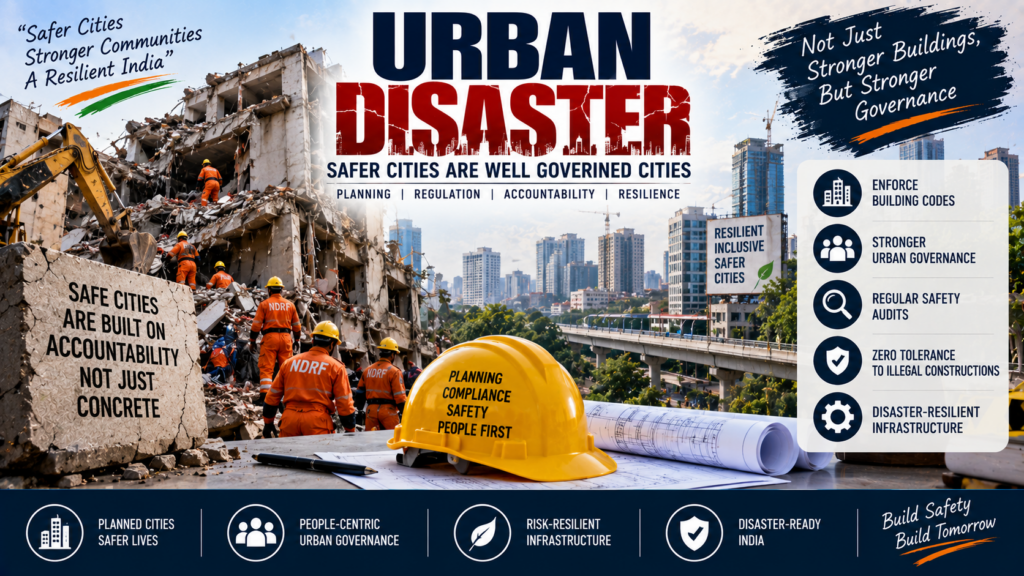
QUESTION: “Urban safety is ultimately a governance challenge, not merely an engineering challenge.” Discuss with reference to building collapses and other infrastructure-related disasters in Indian cities. (150 words)
ANSWER: Urban infrastructure disasters in India—ranging from recurring building collapses and bridge failures to urban flooding and fire accidents—are often attributed to technical flaws or material failures. However, while engineering standards dictate structural stability, it is the governance framework that determines whether these standards are enforced, monitored, and sustained.
The Governance vs. Engineering Paradigm
- The Engineering Dimension: Focuses on structural design, soil testing, load-bearing capacity, quality of construction materials, and adherence to codes like the National Building Code (NBC). These tools and standards exist in detail on paper.
- The Governance Dimension: Enforces these technical standards through urban planning, regulatory oversight, accountability mechanisms, corruption control, and inter-departmental coordination. Engineering failures rarely happen in isolation; they stem from institutional breakdown.
Governance Deficits Behind Infrastructure Disasters
- Regulatory Failure & Unchecked Illegal Constructions: Building collapses (such as those routinely seen in dense urban clusters like Mumbai, Thane, or Delhi) frequently occur because unauthorized floors are added without approval. Local municipal bodies often fail to inspect or halt illegal construction due to regulatory capture and corruption.
- Institutional Fragmentation: Urban management in India suffers from overlapping and uncoordinated jurisdictions. A single city often has multiple agencies—Urban Local Bodies (ULBs), Development Authorities (e.g., DDA, BDA), Public Works Departments (PWD), and specialized parastatals. This leads to accountability diffusion during infrastructure failures like road cave-ins or bridge collapses.
- Weak Implementation of the 74th Constitutional Amendment: ULBs remain financially weak, understaffed, and dependent on state governments. Lacking technical manpower, municipal corporations are unable to perform periodic structural audits of aging buildings or audit private developments effectively.
- Complicity and Corruption in Approval Processes: Environmental Clearances, Fire No-Objection Certificates (NOCs), and Occupancy Certificates (OCs) are frequently issued through corrupt practices or political patron-client networks, bypassing mandatory safety audits.
- Flawed Procurement & Rent-Seeking in Public Contracts: Infrastructure projects, such as flyovers or bridges, often suffer from lowest-bidder ($L_1$) procurement models without robust quality checks. Bribe networks lower the effective budget for actual construction, incentivizing contractors to compromise on engineering standards.
- Neglect of Safety Audits for Aging Infrastructure: The governance mechanism focuses almost entirely on creation (capital expenditure) rather than maintenance and safety monitoring (operational expenditure). Bridges and old residential structures collapse primarily due to the absence of periodic audit regimes.
Way Forward for Robust Urban Governance
- Single-Point Accountability: Establish a unified Urban Metropolitan Transport / Infrastructure Authority in major cities to eliminate jurisdictional overlap.
- Digital Transparency: Mandate GIS-mapped digital building plan approvals, third-party structural audit certifications, and public disclosures of building safety ratings.
- Capacity Building of ULBs: Empower municipal corporations financially and technically by hiring qualified structural engineers and urban planners dedicated to compliance enforcement.
- Whistleblower Protections & Strict Penalties: Implement stringent criminal liability frameworks for public officials and private contractors found guilty of regulatory negligence leading to loss of life.
Urban safety cannot be secured by better engineering designs alone. Without political willpower, institutional accountability, and transparent enforcement mechanisms, safety codes remain unenforced on paper while risks multiply on the ground.
|