
|
IN NEWS: The political cost of UCT schemes
QUESTION: Targeting errors in welfare delivery are not merely administrative failures; they can also have significant social and political consequences. Discuss the causes of inclusion and exclusion errors and suggest measures to address them. (15 marks, 250 words)
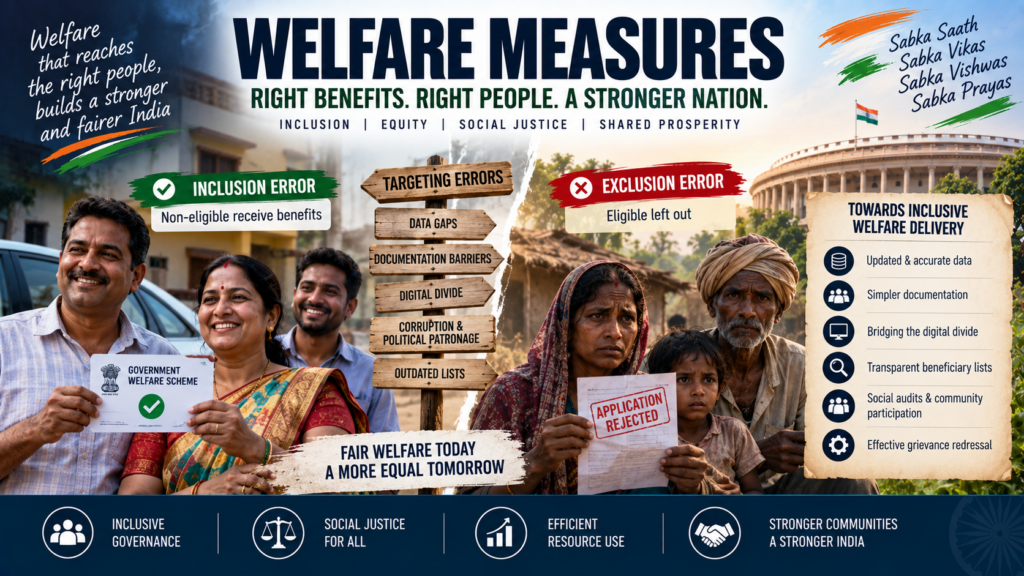
ANSWER: In targeted welfare delivery, inclusion errors occur when non-eligible, relatively affluent households receive benefits meant for the poor, while exclusion errors occur when genuinely needy households are left out. Rather than being simple administrative slip-ups, these errors undermine distributive justice and trigger wider social and political repercussions.
Social and Political Consequences
- Erosion of Social Cohesion and Increased Friction: Exclusion errors create deep-seated resentment among poor households who see their neighbors—often with comparable or higher socio-economic status—receiving benefits due to inclusion errors. This breeds localized jealousy, friction, and distrust among communities.
- Marginalization and Vulnerability: Exclusion from basic safety nets like food security or cash transfers exacerbates extreme poverty, leads to distress migration, and drives vulnerable sections toward informal debt cycles or systemic starvation.
- Political Anti-Incumbency and Distrust: Beneficiaries left out of welfare schemes often perceive the state as discriminatory or corrupt. This leads to political anti-incumbency, public protests, and a broader breakdown of the democratic social contract between citizens and the state.
- Fiscal Misallocation and Waste: Inclusion errors divert scarce public capital away from capital creation, healthcare, and education, resulting in inefficient social expenditure.
Causes of Inclusion and Exclusion Errors
- Dependence on Outdated and Proxy Data: Welfare lists often rely on old baseline surveys (e.g., SECC 2011) or unobservable informal sector incomes. Governments use proxy indicators (land size, electricity usage), which fail to capture dynamic poverty shifts caused by health shocks or climate risks.
- Documentation and Administrative Barriers: Rigid documentation demands—such as mandatory possession of specific identification cards, caste certificates, or proof of residence—disproportionately exclude illiterate, migrant, and marginalized populations.
- Technological Failure and Digital Divide: Over-reliance on biometric authentication (e.g., Aadhaar verification issues) and digital portals leads to technological exclusions due to poor connectivity or physical wear among manual laborers.
- Corruption and Political Patronage: Inclusion errors are frequently driven by local elite capture, rent-seeking behavior by local officials, and political patronage networks that deliberately include ineligible voters.
- Lack of Grievance Redressal and Awareness: A lack of proactive disclosure and complex administrative machinery mean poor citizens often do not know how to contest improper exclusion or verify why they were rejected.
Measures to Address Targeting Errors
- Dynamic Data Architecture: Move away from static baseline surveys toward auto-updated registries that automatically update household status using real-time government databases (e.g., land records, tax databases, vehicle registrations).
- Self-Targeting and Quasi-Universal Mechanisms: Shift toward universal or semi-universal coverage for highly essential services (e.g., public distribution of food grains or maternal health). Universal schemes minimize targeting costs and completely eliminate exclusion errors.
- Community-Led Verification and Social Audits: Empower Gram Sabhas and local urban bodies to publicly review and verify beneficiary lists. Mandatory social audits make eligibility criteria visible and allow community-driven exclusion of affluent households.
- Offline Exception Protocols: Establish mandatory offline override mechanisms alongside digital authentication to ensure no genuine beneficiary is denied benefits due to technological or biometric failures.
- Robust and Time-Bound Grievance Redressal: Institutionalize statutory social accountability frameworks (e.g., Right to Public Services Acts) with dedicated village-level grievance helpdesks where appeals against exclusion are resolved within a fixed timeframe.
While inclusion errors drain fiscal resources, exclusion errors pose a far greater threat by depriving the most vulnerable of fundamental socio-economic rights. Moving toward transparent, community-verified, and technologically resilient social protection frameworks ensures that welfare delivery remains inclusive, equitable, and capable of fostering long-term social trust.
|
SOURCE: The Hindu e-paper – The political cost of UCT schemes