
|
IN NEWS: Why is the Centre opposed to totalisers?
QUESTION: What is a totaliser machine? Explain how it can strengthen the secrecy of voting patterns and examine the arguments for and against its introduction in India.
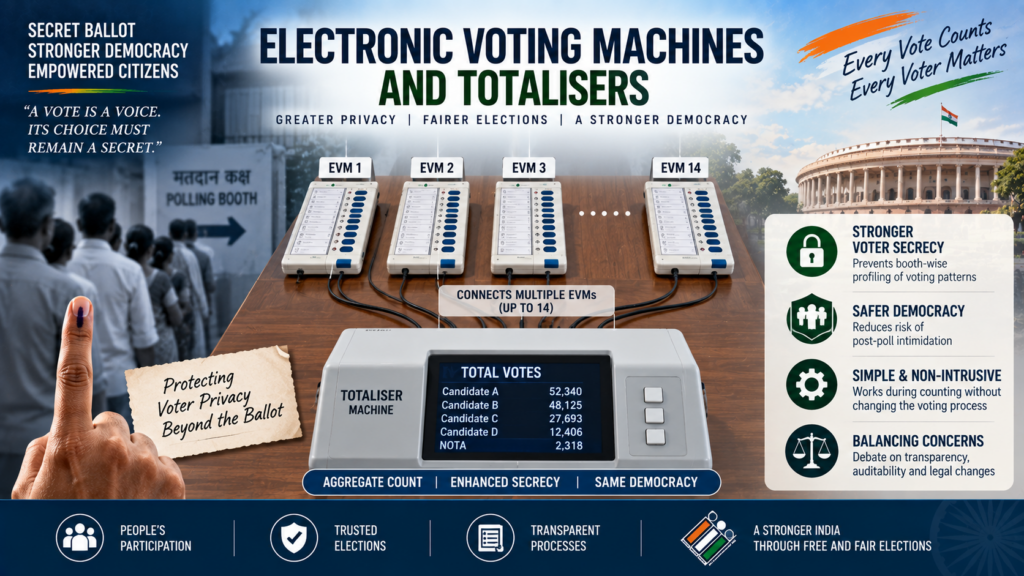
ANSWER: A Totaliser Machine is an electronic device developed by public sector undertakings (Bharat Electronics Limited and Electronics Corporation of India Limited) to consolidate vote tallies from multiple Electronic Voting Machines (EVMs) simultaneously.
Under the current vote-counting process in India, the Control Unit of each EVM is evaluated individually, revealing the exact number of votes each candidate received at that specific polling booth. A totaliser machine connects up to 14 EVM Control Units at a time via cables and displays a single, aggregate vote count for the candidate across the entire group of booths.
Strengthening the Secrecy of Voting Patterns
While individual vote secrecy is preserved under the secret ballot system, the existing booth-wise counting mechanism compromises spatial or neighborhood voting secrecy. By aggregating counts across clusters of 14 polling stations (covering roughly 10,000 to 14,000 voters), a totaliser machine enhances electoral secrecy in several key ways:
- Eliminating Booth-Wise Profiling: It prevents political parties and candidates from analyzing exact voting preferences down to a single polling station, village, or urban block.
- Mitigating Post-Poll Victimization: By concealing local voting trends, it protects vulnerable communities, social groups, or specific localities from target harassment, political coercion, or the withholding of public welfare delivery by victorious candidates.
- Mirroring Paper Ballot Mixing: It restores the protective intent of Rule 59A of the Conduct of Elections Rules (1961), which originally allowed paper ballots from different boxes to be mixed together before counting to obscure booth-level outcomes.
Arguments For Its Introduction
- Protection of Electoral Anonymity: Endorsed by the Law Commission of India in its 255th Report and supported by the Election Commission of India (ECI), it addresses a significant gap in voter privacy by masking local voting distributions.
- Prevention of Political Coercion: It neutralizes post-election intimidation, pre-election voter bribery, or threats by local power brokers who attempt to enforce political compliance through booth-level monitoring.
- Non-Intrusive Integration: The device functions purely as a counting aid during the tallying phase without requiring structural modifications to the EVMs or disrupting the voter’s experience at the polling station.
- Free and Fair Electoral Environment: Ensuring micro-level voter privacy instills confidence in marginalized populations to vote without fear of post-election retaliation.
Arguments Against Its Introduction
- Reconciliation and Audit Complications: Aggregating 14 EVMs simultaneously complicates cross-verification with Form 17C (which records the exact accounts of votes at each booth) and makes matching individual Voter Verifiable Paper Audit Trail (VVPAT) slip counts to a specific EVM difficult during audits.
- Loss of Granular Transparency for Candidates: Polling agents and candidates lose the ability to detect localized mechanical errors, discrepancies, or voter turnout anomalies that could otherwise be caught during a booth-by-booth tally.
- Electoral Strategy and Democratic Analysis: Granular booth-level data is relied upon by political parties to assess local performance, analyze developmental demands, and design targeted policy outreach.
- Statutory and Regulatory Hurdles: Implementing the totaliser requires amendments to the Conduct of Elections Rules, 1961, and potential legislative changes to the Representation of the People Act, 1951, which have faced opposition from political parties due to concerns over auditing transparency.
|
SOURCE: The Hindu e-paper – Why is the Centre opposed to totalisers?