
|
IN NEWS: ‘Early Harvest’ — larger but not necessarily safer
QUESTION: What is meant by an “Early and Substantial Harvest” in the context of India-China boundary negotiations? Why has it generated strategic concerns in India?
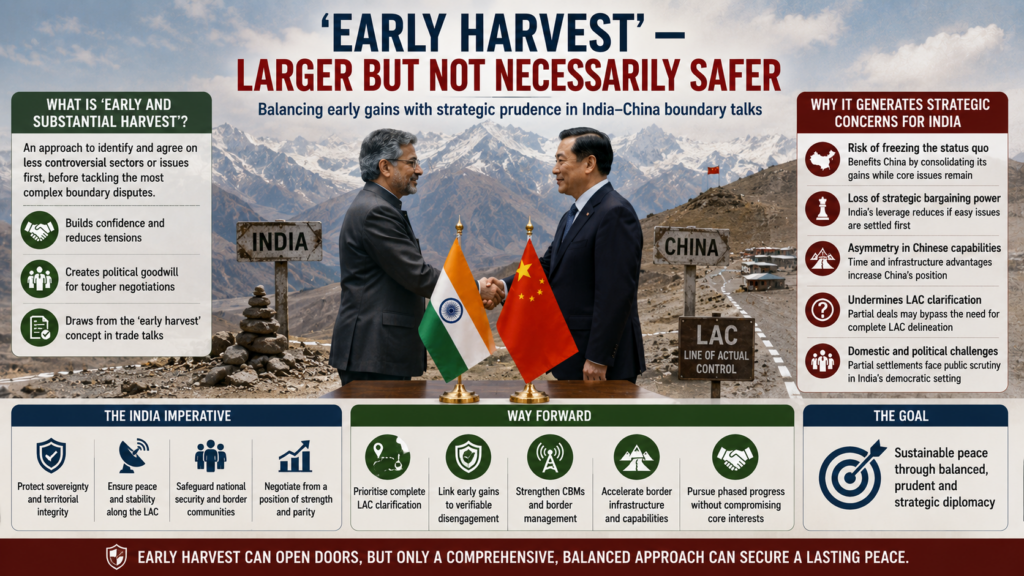
ANSWER: An “Early and Substantial Harvest” in the context of the India-China boundary negotiations refers to an approach where both nations identify, negotiate, and formalize agreements on the less controversial, mutually agreed-upon sectors or aspects of the Line of Actual Control (LAC) before attempting to resolve the most difficult, high-friction territorial disputes. Inspired by trade negotiations—where an “early harvest” gives quick wins to build momentum—the concept aims to create confidence-building measures (CBMs), de-escalate tension, and build diplomatic trust.
Core Meaning and Mechanism
- Phased Resolution: Rather than aiming for a single, comprehensive boundary settlement (a “package deal”), the approach breaks the dispute into manageable segments.
- Capitalizing on Convergence: It focuses first on sectors where cartographic overlap is minimal or where historical consensus largely exists (e.g., sectors of the Middle Sector of the boundary).
- Consolidation of Trust: By delivering early, tangible outcomes—such as clear border demarcation in calmer zones, enhanced protocols for border personnel, or joint military hotline operationalization—both sides hope to generate political goodwill necessary to tackle complex areas like Aksai Chin or Arunachal Pradesh.
Strategic Concerns Generated in India
- Risk of Freezing the Status Quo to China’s Advantage: Settling easier sectors first leaves the major disputed areas (Western/Eastern sectors) unresolved. Critics argue this allows China to consolidate its military gains and infrastructure advantages in key tactical areas while locking in concessions where India holds leverage.
- Loss of Strategic Bargaining Power: Resolving minor disputes early depletes India’s leverage. In a holistic negotiation, India can trade concessions in one sector for advantages in another. A piecemeal “harvest” strips away trade-offs, leaving India with limited operational leverage when addressing core territorial claims.
- Asymmetry in Chinese Capabilities: China’s rapid construction of dual-use “Xiaokang” border villages, airfields, and road networks along the LAC means that time often works in Beijing’s favor. An incremental process gives China time to alter ground realities (salami slicing tactics) before negotiations reach disputed sectors.
- Undermining the Clarification of the LAC: India has long insisted that clarifying the alignment of the LAC is a mandatory prerequisite to any boundary settlement. An “Early Harvest” risks bypassing a full LAC clarification, leaving ambiguous operational zones open to future incursions.
- Public and Political Backlash: In India’s democratic setup, accepting partial settlements that leave vast swathes of claimed territory unaddressed is politically difficult and vulnerable to domestic opposition, whereas China’s top-down system faces no such constraints.
Way Forward
- Mandatory LAC Clarification: Prioritize formal exchange of maps and spatial data for the entire LAC to establish a common baseline, preventing grey-zone aggression while negotiations proceed.
- Linking Progress to Comprehensive Disengagement: Any early agreement in lower-friction zones must be conditional on verifiable, complete disengagement and de-escalation in high-tension areas (such as Demchok and Depsang).
- Institutionalized Border Management: Strengthen and upgrade existing CBMs—including direct local commander communication lines and joint patrol coordination—to ensure tactical stability regardless of the pace of political talks.
- Symmetric Capability Building: Accelerate Indian border infrastructure development (vibrant village programs, strategic road networks, and forward airbases) to ensure India negotiates from a position of strategic parity.
|
SOURCE: The Hindu e-paper – ‘Early Harvest’ — larger but not necessarily safer