
|
IN NEWS: Political demography, the future of democracy
QUESTION: “The principle of ‘one person, one vote, one value’ must be reconciled with the federal and representational concerns arising from India’s uneven demographic transition.” Discuss.
(250 words)
ANSWER: The principle of “one person, one vote, one value” guarantees equal political weight to every citizen in a democracy. In India, this is operationalized through Article 82 and Article 170, which mandate the readjustment of Lok Sabha and State Assembly seats based on population census data via a Delimitation Commission.
However, India’s uneven demographic transition—where Southern and Western states achieved replacement-level fertility decades ahead of Northern states—creates a profound constitutional tension between political equality and federal equilibrium.
- The Core Tension: Democratic vs. Federal Principles
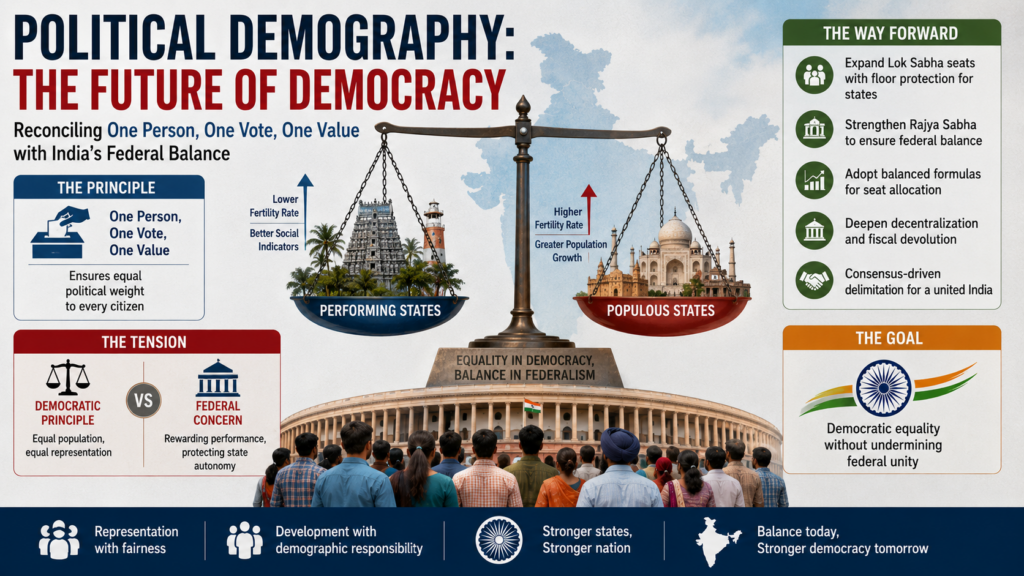
- Democratic Principle (One Person, One Vote, One Value): Requires Lok Sabha constituencies to represent roughly equal populations across the nation. Populous states argue that failing to delimit seats based on current population under-represents their citizens in Parliament.
- Federal Concern (Rewarding Performance & Protecting Autonomy): Southern and Western states argue that updating seats using post-1971 population numbers penalizes them for successfully implementing national population control policies, transferring political power to higher-fertility states.
- Historical & Legal Background
To prevent Southern states from being politically penalized during the height of family planning efforts, successive constitutional amendments froze the allocation of Lok Sabha seats to states:
- 42nd Constitutional Amendment Act (1976): Froze the allocation of seats based on the 1971 Census until after the 2001 Census.
- 84th Constitutional Amendment Act (2002): Extended this freeze until the first census taken after 2026 (effectively delaying delimitation until data from the post-2026 census is available).
- 87th Constitutional Amendment Act (2003): Allowed intra-state delimitation (redrawing boundaries within a state) based on the 2001 Census without changing the total number of seats allocated to each state.
- Key Concerns Arising from Uneven Demographic Transition
- Demographic Disparity Across Regions: Southern states like Kerala and Tamil Nadu have Total Fertility Rates (TFR) well below replacement level ($\sim1.5 \text{ to } 1.8$), whereas Northern states like Bihar and Uttar Pradesh have historically had higher fertility rates.
- Political & Representational Imbalance: If delimitation occurs strictly according to projected post-2026 population figures, Northern states (e.g., Uttar Pradesh, Bihar) would gain significant representation in the Lok Sabha, while Southern states (e.g., Tamil Nadu, Kerala, Karnataka, Andhra Pradesh, Telangana) would see their relative proportion of seats shrink significantly.
- Impact on Cooperative Federalism: Changes in political weight directly influence legislative priorities, revenue sharing discussions (such as the Finance Commission formula), and central project distribution. States that performed well on social indicators risk losing political leverage to states that lagged behind.
- Strategic Pathways to Reconcile the Dilemma
Achieving equilibrium requires balancing democratic equality with federal stability through structural and institutional reforms:
- Expansion with Floor Protection: Increase total Lok Sabha seats (e.g., utilizing the expanded Parliament capacity) while ensuring no state loses its current absolute number of seats. This prevents an absolute loss for performing states, even as relative proportions adjust.
- Strengthening Rajya Sabha: Enhance the legislative authority and federal parity in the Upper House to provide a counterweight to population-dominated Lok Sabha decisions.
- Weighted Representation Formulas: Introduce a formula for seat distribution that combines population data with developmental, demographic performance, and governance indicators to cap extreme variance.
- Deeper Decentralization: Strengthen local governance under the 73rd and 74th Constitutional Amendments, ensuring fiscal and administrative devolution counterbalances central representation shifts.
Reconciling population-based representation with Indian federalism requires moving beyond strict demographic arithmetic. A consensus-driven delimitation process must pair Lok Sabha expansion with protections for high-performing states, ensuring that democratic equality does not undermine national unity and cooperative federalism.
|
SOURCE: The Hindu e-paper – Political demography, the future of democracy