
|
IN NEWS: Adopt policies for reuse of treated water
QUESTION: “India’s wastewater challenge is increasingly a question of resource recovery rather than merely sewage disposal.” In this context, examine the potential of treated wastewater reuse for India’s water security. Assess the adequacy of existing government initiatives and suggest measures to bridge the implementation gap. (15 Marks)
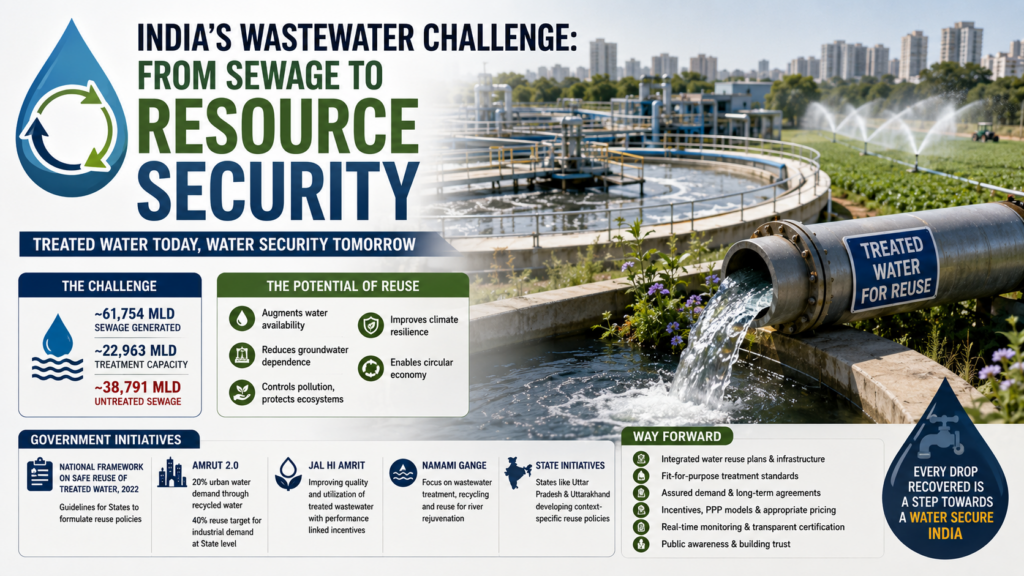
Answer: India faces the paradox of growing water stress alongside increasing wastewater generation. As per CPCB estimates, urban India generates around 61,754 MLD of sewage, against treatment capacity of about 22,963 MLD, leaving nearly 38,791 MLD untreated. This highlights that India’s water challenge is not merely about creating new sources, but also about recovering and efficiently reusing the water it already consumes.
Potential of treated wastewater reuse
Treated wastewater can become an important component of India’s water-security strategy.
- Augments water availability: It can substitute freshwater for agriculture, industries, construction, landscaping and other non-potable requirements.
- Reduces groundwater dependence: Reuse can moderate extraction from increasingly stressed aquifers around urban centres.
- Controls pollution: Effective treatment and reuse reduces the discharge of sewage into rivers, lakes and other water bodies.
- Improves climate resilience: Recycled water can provide a relatively dependable source during droughts and periods of rainfall variability.
- Promotes circular economy: It enables a shift from the conventional extract-use-discharge model towards treat-reuse-recover.
Existing government efforts
- India has gradually developed a policy architecture for wastewater reuse. The National Framework on Safe Reuse of Treated Water, 2022 provides guidance for States to formulate context-specific reuse policies.
- AMRUT 2.0 has placed recycling and reuse within urban water-security planning and envisages meeting 20% of urban water demand through recycled water, besides a 40% reuse target for industrial water demand at the State level.
- The Jal Hi AMRIT initiative seeks to improve the quality and utilisation of treated wastewater through performance-linked incentives. Namami Gange has also increasingly incorporated wastewater treatment, recycling and reuse within river rejuvenation efforts.
- Recent initiatives in Uttar Pradesh and Uttarakhand further demonstrate that wastewater reuse is moving towards State-specific policy frameworks suited to different geographical and demand conditions.
Gaps in implementation
However, the principal challenge is the gap between treatment capacity and actual reuse.
- First, an STP does not automatically create a reuse system. Absence of dedicated pipelines, storage, tertiary treatment and assured users often results in treated water being discharged rather than productively reused.
- Second, institutional fragmentation among ULBs, irrigation agencies, industries, pollution-control authorities and water utilities prevents integrated planning.
- Third, economic incentives remain weak. Where freshwater is inadequately priced, industries and other users may have little incentive to purchase recycled water, particularly when additional treatment and transportation are required.
- Fourth, concerns regarding water quality and health, along with public resistance towards treated wastewater, constrain wider adoption.
Way forward
India needs to move from a narrow focus on “sewage treatment” to “water resource recovery.” States and cities should prepare integrated water-reuse plans identifying wastewater sources, potential users, quality requirements and distribution infrastructure.
A fit-for-purpose approach should match treatment standards with end use. Assured demand can be created through long-term agreements with industries and bulk users, while appropriate pricing, incentives and PPP models can improve financial viability. Real-time quality monitoring and transparent certification are equally important for building public trust.
The objective should not merely be to treat more wastewater, but to ensure that safely treated water has a productive second use. Converting wastewater into a reliable resource can simultaneously strengthen water security, pollution control, climate resilience and the circular economy.
|
SOURCE: The Hindu e-paper – Adopt policies for reuse of treated water