
As you are determined to become an IAS officer, understanding the UPSC syllabus helps you to grasp the backbone of this Civil Services Examination.
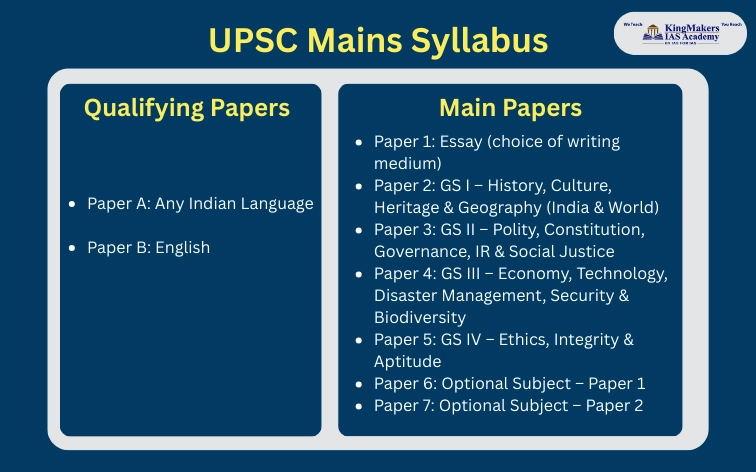
The UPSC syllabus comprises three parts, namely, Prelims, Mains, and Interview. Prelims exam consists of objective type of questions and Mains examination has 9 papers (Essay (1), GS I-IV (4), Optional Subject Papers I-II (2), Qualifying: Indian Language & English) followed by an Interview focusing on current affairs, history, geography, polity, economy, environment, ethics, etc. Each part of the syllabus requires specific strategies, expert guidance, and intensive practice to build the expertise.
This UPSC Syllabus 2026 blog is committed to answer all your questions regarding the UPSC CSE exam. And, one more thing, don’t forget to download the UPSC syllabus PDF which can be kept handy.
Having the expert mentorship on one side, and the intensive practice sessions on the other side allows you to easily crack the UPSC examination. Join KingMakers IAS academy, the best and trusted IAS coaching centre in Chennai, helps you to achieve the highest UPSC score!
UPSC Syllabus 2026 – A Brief Overview
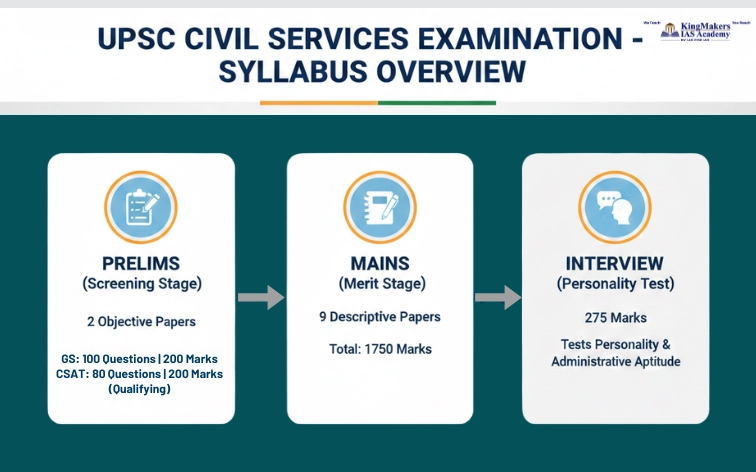
IAS aspirants should go through the latest UPSC syllabus to plan their preparation accordingly. There are two main stages in UPSC syllabus that candidates must understand, which are Prelims and Mains, followed by an interview. Each stage of the syllabus covers wide range of topics and subjects, which we have discussed below:
- UPSC Prelims: The first stage of UPSC is Preliminary examination, which has two objective type papers. The General Studies (GS) paper has 100 questions carrying 200 marks, while the CSAT paper has 80 questions carrying 200 marks.
- UPSC Mains: The second stage is called the UPSC Mains examination. It has 9 descriptive-type papers, worth 1750 marks.
- UPSC Interview (Personality Test): The last stage of UPSC journey is Personality test, where candidates’ administrative aptitude will be tested and measured with 275 marks.
It is understandable that you are curious to know the entire syllabus of UPSC Civil Services examination. You might not have the time to read it now itself, but you can use your time to download the PDF, which you can keep handy and read afterwards.
This is the main and essential information regarding the UPSC syllabus. In the succeeding sections, we are providing the detailed UPSC syllabus breakdown for Prelims, Mains and Interview.
UPSC Prelims Syllabus (Objective Type; GS: 200 Marks & CSAT: 200 Marks )
In this section, you can understand the UPSC Prelims Syllabus in detail. As we have already mentioned, it has two objective type papers (don’t think I am repeating, just to help you to strengthen the memory). Let’s understand these two crucial papers inside the UPSC Prelims:
UPSC Prelims Syllabus Paper 1: General Studies (GS)
The General studies 1 paper, under UPSC Prelims syllabus, designed to test the candidates’ overall knowledge and awareness about the country. It contains 100 questions, carries 200 marks with a negative marking of 1/3rd (0.66 marks) for every incorrect answer. The exam duration is around 2 hours and it acts as a qualifying examination for the candidates to enter UPSC Mains exam.
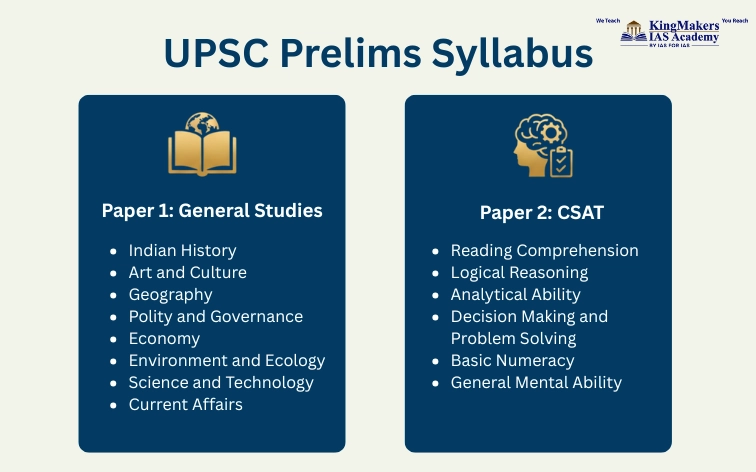
This GS 1 Paper spans a wide range of subjects like History, Polity, Geography, Economy, Environment, Science and Technology, and Current affairs.
What are the Topics GS1 Paper Covers?
- Indian History (Ancient, Medieval, Modern Freedom Struggle)
- Art and Culture (Architecture, Literature, Performing Arts)
- Geography (Physical, Human, Indian Physiography, Climatology)
- Polity and Governance (Constitution, Institutions, Panchayati Raj)
- Economy (Planning, Agriculture, Budgeting, Infrastructure)
- Environment and Ecology (Biodiversity, Climate Change, Conservation)
- Science and Technology (Biotech, Space, IT, Nuclear)
- Current Affairs (National/International Events, Reports, Indices)
UPSC Prelims Syllabus Paper 2: Civil Services Aptitude Test (CSAT)
The CSAT Exam of UPSC Prelims tests the candidates’ reasoning, comprehension, basic numeracy, analytical thinking and decision making skills. It comprises 80 questions, with an overall mark of 200 and deducts 1/3rd (0.83 marks) as a negative marking for the wrong answers. The duration of this UPSC Prelims Paper 2 is 2 hours, dealing with subjects and skills such as reasoning and analysis, quantitative aptitude, general mental ability, and data interpretation. In the following section, we have given the topics covered in the UPSC Prelims CSAT exam.
What are the Topics CSAT Paper Covers?
- Reading Comprehension (Passages, Inference)
- Logical Reasoning (Syllogism, Puzzles, Blood Relations, Coding-Decoding)
- Analytical Ability (Direction Sense, Seating Arrangement, Data Sufficiency)
- Decision Making and Problem Solving (Ethical Dilemmas, Situations)
- Basic Numeracy (Numbers, Percentages, Profit/Loss, Time/Work)
- General Mental Ability (Geometry, Mensuration, Series)
Note: More precisely, the CSAT paper is a qualifying examination, and candidates must secure the minimum qualifying marks for the General Studies paper to be evaluated. Only the marks obtained in the GS paper are counted toward the merit list for qualifying for the UPSC Mains examination.
In the below-given table, we have given the essence of UPSC Prelims Syllabus, its two papers along with the subjects it covers, number of questions, total marks and duration.
| Paper | Subjects | No. of Questions | Total Marks | Duration |
| GS Paper I | Current events, History, Geography, Polity, Economy, Environment, Science | 100 | 200 | 2 hours |
| CSAT Paper II (Qualifying, 33% required) | Comprehension, Logical Reasoning, Basic Numeracy, Data Interpretation | 80 | 200 | 2 hours |
In the below video, we have explained the way to plan and crack the UPSC Prelims 2026 in the most efficient way possible!

UPSC Mains Syllabus (Descriptive Type; 1750 Marks)
Below, we have brought out the complete UPSC Mains Syllabus covering all the topics it entails.
UPSC Mains Syllabus Paper 1: Essay
UPSC Mains Essay is focused to test the candidates’ structured thinking, coherence, and persuasive writing across diverse themes, carrying 250 marks. In the following we have listed the important topics covered in UPSC Mains GS 1 Paper:
Philosophical Themes
- Essence of ethics and human actions
- Morality in public life
- Values from great thinkers and leaders
Socio-Economic Development
- Inclusive growth challenges
- Poverty eradication strategies
- Women empowerment dynamics
Environment and Sustainability
- Climate change imperatives
- Sustainable development models
- Resource conservation ethics
Governance and Democracy
- Crisis in democracy
- Federalism tensions
- Judicial activism role
Technology and Society
- AI ethical dilemmas
- Digital divide impacts
- Innovation vs regulation
UPSC Mains Syllabus Paper 2: General Studies 1 (GS 1)
UPSC Mains GS 1 examination tests the candidates’ knowledge and expertise in historical, cultural, geographical, and societal analysis. This paper as well carries 250 marks. Below, we have given the major topics covered in the UPSC Mains Syllabus Paper 2 – General Studies 1:
Indian Heritage and Culture
- Salient art forms (painting, sculpture)
- Architectural evolution (temples, monuments)
- Literature traditions (ancient to modern)
Modern Indian History
- Freedom struggle phases
- Key personalities and movements
- Post-1947 consolidation (states reorganization)
World History
- Industrial Revolution effects
- World Wars and decolonization
- Political philosophies (communism, fascism)
Physical Geography
- Salient physiographic features
- Climatology and oceanography
- Natural disasters distribution
Human Geography and Society
- Urbanization trends
- Globalization effects
- Social issues (poverty, communalism, women)
UPSC Mains Syllabus Paper 3: General Studies 2 (GS 2)
In UPSC Mains GS 2 Paper, the candidates are evaluated on polity, governance, justice, and IR understanding, carrying 250 marks. In the following, we have listed the important topics covered in UPSC Mains GS 2 Paper.
Constitution and Polity
- Preamble, fundamental rights
- Directive Principles application
- Parliament, state legislatures functioning
Governance Issues
- Transparency mechanisms (RTI)
- E-governance initiatives
- Citizen charters implementation
Social Justice
- Welfare schemes for vulnerable
- Health, education policy issues
- Poverty alleviation programs
International Relations
- India-Pakistan, China dynamics
- Bilateral/multilateral engagements
- Global institutions (UN, WTO) reforms
UPSC Mains Syllabus Paper 4: General Studies 3 (GS 3)
The candidates’ knowledge on economic, tech, security, and environmental expertise is assessed in UPSC Mains GS 3 Paper, which carries 250 marks. Find the essential topics covered in this paper, below:
Indian Economy
- Growth trends and resource mobilization
- Inclusive development strategies
- Budgeting, banking reforms
Agriculture and Industry
- Major crops, irrigation patterns
- Food processing industries
- Land reforms effects
Science and Technology
- Indigenization efforts
- Space, biotech achievements
- IPR issues
Environment and Security
- Biodiversity hotspots
- Climate change mitigation
- Internal security (terrorism, cyber threats)
UPSC Mains Syllabus Paper 5: General Studies 4 (GS 4)
UPSC Mains GS 4 Paper focused on the questions related to ethics, integrity, and aptitude in administration, carrying 250 marks. In the following, we have listed the important topics covered in UPSC Mains GS 4 Paper.
Ethics Foundations
- Human interface determinants
- Attitude influences
- Emotional intelligence applications
Governance Ethics
- Civil service values
- Ethical concerns in funding
- Corruption prevention strategies
Aptitude and Case Studies
- Decision-making frameworks
- Probity in governance
- Administrative ethics dilemmas
UPSC Mains Syllabus Optional Subjects (Paper 1 & Paper 2)
UPSC Mains Optional Subjects demand subject mastery from 48 choices (core and literature), each 250 marks.
Popular Core Subjects
- History: Ancient civilizations, medieval polity
- Geography: Geomorphology, economic geography
- Public Administration: Theories, accountability
- Sociology: Social stratification, change
Literature Subjects
- Hindi/English: Poetry, prose analysis
- Tamil/Sanskrit: Classical texts, modern works
- Comparative literature themes
Analytical Components
- Current affairs linkages
- Policy/case applications
- Theoretical debates
UPSC Mains Syllabus for Qualifying Language Papers (Any Indian Languages & English)
UPSC Mains Qualifying Language Papers test basic proficiency, each 300 marks (qualifying threshold).
Comprehension Skills
- Passage understanding
- Precis summarization
- Inference questions
Writing Proficiency
- Essay on given topics
- Formal letter writing
- Report composition
Grammar and Translation
- Error detection/correction
- Idioms and phrases
- Language-to-English translation
In the following table, we have provided the overview of UPSC Mains Syllabus, its nine papers along with the subjects, number of questions, total marks, and the duration.
| Paper | Subjects | No. of Questions | Total Marks | Duration |
| A (Qualifying) | Indian Language | Varies (Essay, Precis, etc.) | 300 | 3 hours |
| B (Qualifying) | English | Varies (Essay, Precis, etc.) | 300 | 3 hours |
| I | Essay | 2 essays | 250 | 3 hours |
| II | GS I (History, Geography, Society) | 20 | 250 | 3 hours |
| III | GS II (Polity, Governance, IR) | 20 | 250 | 3 hours |
| IV | GS III (Economy, Tech, Environment, Security) | 20 | 250 | 3 hours |
| V | GS IV (Ethics, Integrity) | 13 questions + 6 case studies | 250 | 3 hours |
| VI | Optional Subject Paper 1 | Varies | 250 | 3 hours |
| VII | Optional Subject Paper 2 | Varies | 250 | 3 hours |
In the following video, our faculty Mr.Adil Baig chats with UPSC CSE 2024 Topper Mr Harikrishnan AIR 784, about his Mains preparation strategy. It will be useful to every serious IAS aspirant!

UPSC Interview Syllabus ( Personality Test; 275 Marks)
UPSC Interview is structured in diverse ways where the candidates’ skills, personality traits, current affairs and critical thinking are tested to figure out the capability to become IAS officers. Below, we have given the required skills, question types and themes helping the IAS aspirants to handle the UPSC Personality test in a better way.
Required Skills
- Analytical aptitude and critical thinking
- Mental alertness and quick assimilation
- Clear and logical communication
- Leadership and social cohesion abilities
- Balance of judgment and decision-making
- Emotional intelligence and integrity
- Intellectual depth and variety of interests
Question Types
- Personal background questions (DAF-based)
- Situational/ethical dilemmas
- Opinion-based on current affairs
- Hobby and interest probes
- Work experience or academic challenges
- Abstract or hypothetical scenarios
- Leadership and teamwork examples
Main Themes
- Current national/international events
- Constitutional values and governance
- Social issues (poverty, gender, diversity)
- Economic policies and development
- Environmental challenges and security
- Personal ethics and public service motivation
- India’s foreign relations and culture
The following table provides the major information required you to get the overall idea about UPSC Interview Syllabus:
| Focus Area | What Panel Tests | Typical Question Styles | Key Preparation Tips |
| Personal Details | Background, values, motivation | Tell us about your hometown and its challenges. | Review DAF thoroughly; prepare 2-min bio pitch |
| Education/Work | Knowledge depth, experiences | Why the gap in your career? Explain your project. | Link to civil services; practice explaining achievements |
| Optional Subject | Conceptual clarity | Recent debates in your optional field? | Revise core syllabus; read latest papers |
| Current Affairs (National) | Awareness, analysis | Views on recent policy like NEP 2025? | Daily newspaper; form balanced opinions |
| Current Affairs (International) | Global perspective | India’s stance on Ukraine-Russia conflict? | Follow The Hindu editorials; track bilateral ties |
| State/Region Issues | Local insight | Challenges in your home state cadre? | Study home state + preferred cadres’ economy/social issues |
| Ethics & Values | Integrity, decision-making | How would you handle corruption in a team? | Practice case studies; use GS4 framework |
In the below video, Mr. Adil Baig speaks to Saranya, the UPSC CSE 2024 topper, who scored a remarkable 210 marks in the Personality Test, becoming the state topper in the interview round. It will be helpful for every aspirant aiming to excel in the UPSC Personality Test stage.

Bonus: How to Choose the Suitable UPSC Optional Subject?
Below, we have given the several points that serves as guidelines to choose the suitable optional subject for UPSC examination:
- Read the Syllabus: The first and foremost thing is to read and analyze the syllabus of optional subjects. Ensure to get the sense of the length of the syllabus and the subjects it covers.
- Expertise and Preference: Identify the subjects you already have expertise and then consider your interests and preference when it comes to choosing the optional subjects. Both factors come into play in the game of learning the UPSC materials.
- Availability of Materials: Check whether you are having the materials or not for the available optional subjects. Considering this factor can help you in the long run.
In UPSC Mains examination, there are a total of 48 optional subjects (25 core subjects & 23 literature optional) available for the candidates to choose.
Core Subjects
| Agriculture | Animal Husbandry | Anthropology | Botany | Chemistry |
| Civil Engineering | Commerce & Accountancy | Economics | Electrical Engineering | Geography |
| Geology | History | Law | Management | Mathematics |
| Mechanical Engineering | Medical Science | Philosophy | Physics | Political Science |
| Psychology | Public Administration | Sociology | Statistics | Zoology |
Literature Subjects
| Assamese | Bengali | Bodo | Dogri | Gujarati |
| Hindi | Kannada | Kashmiri | Konkani | Maithili |
| Malayalam | Manipuri | Marathi | Nepali | Odia |
| Punjabi | Sanskrit | Santhali | Sindhi | Tamil |
| Telugu | Urdu | English |
How UPSC Merit is Calculated?
Only the UPSC Mains and Interview round marks will be considered in your final UPSC merit. UPSC Prelims only acts as a qualifying assessment for Mains examination. It will not reflect in your final UPSC merit.
Small Strategy to Digest the UPSC Syllabus
Not every subject or topic is the same, so the method of learning also must be changed. For objective type questions, flashcards can be used to develop recall and mock tests can be implicated to strengthen the memory. For mains-oriented answer writing, regular structured exercises can help the students to develop the ability. And, the Feynman technique is good for understanding abstract concepts, where the subject matter has to be explained to an imaginary audience that exposes gaps and misunderstandings. This tailored strategy helps you to attain the digest and master the subjects more effectively.
Recommended Books to Crack the UPSC Syllabus 2026
In the following, we have provided the list of books which can help you to crack the syllabus and UPSC CSE examination.
- “Indian Polity” by M. Laxmikanth
- “Certificate Physical and Human Geography” by G.C. Leong
- “Indian Art and Culture” by Nitin Singhania
- “Governance in India” by M. Laxmikanth
- “Environment and Ecology” by Majid Husain
- “Lexicon for Integrity, Ethics, and Aptitude”
Get Detailed Information: 25 Recommended Books for IAS by Toppers
Planning to Achieve the Top UPSC Score? Join KingMakers IAS Academy
At KingMakers IAS Academy, we help the IAS aspirants to achieve the ideal UPSC score. Our expert mentors, extensive range of mock tests, comprehensive practice writing exams, and mock interviews guides our students to the UPSC Syllabus more efficiently and effectively. As we know, action matters more, let’s get into the preparation mode and score the best marks in the UPSC CSE examination.
Related Guides
- UPSC Admission
- UPSC Guide for Beginners
- UPSC Age Limit
- How Many Attempts for UPSC?
- UPSC Selection Process
- How to Fill UPSC DAF Application
- Answer Writing Tips for UPSC Mains
- How to Start UPSC Preparation from Zero Level
FAQs: UPSC Syllabus for IAS Aspirants
1. Why is understanding the UPSC Syllabus important for IAS aspirants?
Understanding the UPSC syllabus helps aspirants to clearly grasp the backbone of the Civil Services Examination. It gives direction to preparation, avoids unnecessary reading, and helps candidates focus only on what UPSC actually demands in Prelims, Mains, and Interview.
2. What are the stages covered in the UPSC Syllabus 2026?
The UPSC syllabus consists of three major stages: Preliminary Examination, Mains Examination, and Interview (Personality Test). Each stage tests different skills and requires specific preparation strategies to move forward in the UPSC journey.
3. What is the structure of the UPSC Prelims Syllabus?
The UPSC Prelims syllabus consists of two objective-type papers: General Studies Paper I (100 questions; 200 marks) and CSAT Paper II.
4. How many papers are there in the UPSC Mains Syllabus?
The UPSC Mains exam consists of 9 descriptive papers, including Essay, General Studies I–IV, Optional Subject Papers I & II, and two qualifying language papers (Indian Language and English).
5. What does the UPSC Interview focus on?
The UPSC Interview focuses on assessing a candidate’s personality traits, decision-making ability, ethical thinking, leadership qualities, and awareness of current affairs.
6. How does KingMakers IAS Academy help aspirants master the UPSC Syllabus?
KingMakers IAS Academy provides expert mentorship, structured syllabus coverage, regular mock tests, answer writing practice, and interview guidance. With focused preparation and experienced faculty support, aspirants can understand the UPSC syllabus deeply and prepare effectively to achieve a high UPSC score.