
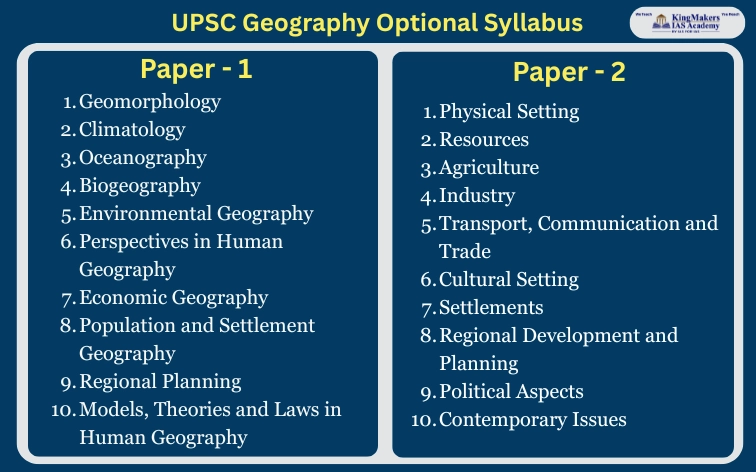
If you are an UPSC aspirant with keen interest in Geography, it means you found the suitable UPSC optional paper. In the Mains examination, you have to choose one optional subject which will be turned into two question papers. Choosing Geography as an optional subject is really an advantage since it is already covered in the Prelims and General Studies Paper 1 of the Mains. UPSC Geography Optional Syllabus, consists of two papers: Paper 1 – The Principles of Geography (Geomorphology, Climatology, Oceanography, etc) and Paper 2 – Geography of India (Physical Setting, Resources, Agriculture, Cultural Setting, etc. Lets find all the essential topics covered in Paper 1 & 2, key preparation tips and downloadable geography UPSC syllabus PDF in this blog.
UPSC Geography Optional Syllabus: A Brief Overview
Geography is one of the most popular optional choice papers of the UPSC aspirants. As per the 73rd Annual Report for 2022-23, it is found that 1,079 students appeared in the exam and obtained the success rate of 6.1%. Out of the 1750 marks in all UPSC Mains papers, optional paper carries a weightage of 500 marks, meaning 250 marks for each paper. So, choosing the right optional subject is the crucial task of the IAS aspirants. Students having an educational background in science, engineering, and environmental studies, or developed a keen interest in space and land of India, can opt for the geography optional paper.
Below, we have given the complete UPSC Geography Optional Syllabus PDF to download and keep it for your reference,
Geography Syllabus for UPSC Optional: Detailed Breakdown
As we discussed, UPSC Geography Optional Syllabus is divided into two papers, where the UPSC aspirants have to learn all the topics relevant to Indian geography, both theoretical and practical aspects.
- Paper 1: Principles of Geography
- Paper 2: Geography of India
UPSC Geography Optional Syllabus Paper 1: Principles of Geography
This paper 1 of geography syllabus for UPSC covers the principles of physical and human geography, which were all listed below in comprehensive manner:
- Geomorphology: Factors controlling landform development; endogenetic and exogenetic forces; Origin and evolution of the earth’s crust; Fundamentals of geomagnetism; Physical conditions of the earth’s interior; Geosynclines; Continental drift; Isostasy; Plate tectonics; Recent views on mountain building; Vulcanicity; Earthquakes and Tsunamis; Concepts of geomorphic cycles and Landscape development; Denudation chronology; Channel morphology; Erosion surfaces; Slope development; Applied Geomorphology: Geohydrology, economic geology and environment.
- Climatology: Temperature and pressure belts of the world; Heat budget of the earth; Atmospheric circulation; Atmospheric stability and instability. Planetary and local winds; Monsoons and jet streams; Airmasses and fronto genesis, Temperate and tropical cyclones; Types and distribution of precipitation; Weather and Climate; Koppen’s, Thornthwaite’s and Trewartha’s classification of world climates; Hydrological cycle; Global climatic change and role and response of man in climatic changes, Applied climatology and Urban climate.
- Oceanography: Bottom topography of the Atlantic, Indian and Pacific Oceans; Temperature and salinity of the oceans; Heat and salt budgets, Ocean deposits; Waves, currents and tides; Marine resources: biotic, mineral and energy resources; Coral reefs, coral bleaching; sea-level changes; law of the sea and marine pollution.
- Biogeography: Genesis of soils; Classification and distribution of soils; Soil profile; Soil erosion, Degradation and conservation; Factors influencing world distribution of plants and animals; Problems of deforestation and conservation measures; Social forestry; agro-forestry; wild life; major gene pool centres.
- Environmental Geography: Principle of ecology; Human ecological adaptations; Influence of man on ecology and environment; Global and regional ecological changes and imbalances; Ecosystem their management and conservation; Environmental degradation, management and conservation; Biodiversity and sustainable development; Environmental policy; Environmental hazards and remedial measures; environmental education and legislation.
- Perspectives in Human Geography: Areal differentiation; regional synthesis; Dichotomy and dualism; Environmentalism; Quantitative revolution and locational analysis; radical, behavioural, human and welfare approaches; Languages, religions and secularisation; Cultural regions of the world; Human development index.
- Economic Geography: World economic development: measurement and problems; World resources and their distribution; Energy crisis; the limits to growth; World agriculture: typology of agricultural regions; agricultural inputs and productivity; Food and nutrition problems; Food security; famine: causes, effects and remedies; World industries: locational patterns and problems; patterns of world trade.
- Population and Settlement Geography: Growth and distribution of world population; demographic attributes; Causes and consequences of migration; concepts of over-under-and optimum population; Population theories, world population problems and policies, Social well-being and quality of life; Population as social capital.
- Types and patterns of rural settlements; Environmental issues in rural settlements; Hierarchy of urban settlements; Urban morphology: Concepts of primate city and rank-size rule; Functional classification of towns; Sphere of urban influence; Rural-urban fringe; Satellite towns; Problems and remedies of urbanization; Sustainable development of cities.
- Regional Planning: Concept of a region; Types of regions and methods of regionalisation; Growth centres and growth poles; Regional imbalances; regional development strategies; environmental issues in regional planning; Planning for sustainable development.
- Models, Theories and Laws in Human Geography: Systems analysis in Human geography; Malthusian, Marxian and demographic transition models; Central Place theories of Christaller and Losch; Perroux and growth poles; Von Thunen’s model of agricultural location; Weber’s model of industrial location; Ostov’s model of stages of growth. Heartland and Rimland theories; Bid-rent analysis; Arterial corridor and hinterland development; Tourism as a tool for regional development.
UPSC Geography Optional Syllabus Paper 2: Geography of India
In the paper 2 of geography syllabus for UPSC exam, physical, economic, cultural and regional aspects of India’s geography will be covered. The following details lets you know the kind of content you are required to know to crack the UPSC geography syllabus:
- Physical Setting: Space relationship of India with neighbouring countries; Structure and relief; Drainage system and watersheds; Physiographic regions; Mechanism of Indian monsoons and rainfall patterns; Tropical cyclones and western disturbances; Floods and droughts; Climatic regions; Natural vegetation; Soil types and their distributions.
- Resources: Land, surface and groundwater, energy, minerals, biotic and marine resources; Forest and wildlife resources and their conservation; Energy crisis.
- Agriculture: Infrastructural factors in the basis of agriculture; Crops, croppings patterns and crop planning; Irrigation policies; agro and social-forestry; Green revolution; Problems of modernisation of Indian agriculture; Dry farming; Seed technology.
- Industry: Evolution of industries; Locational factors of cotton, jute, textile, iron and steel, aluminium, fertilizer, paper, chemical and pharmaceutical, automobile, cottage and agro-based industries; Industrial houses; Industrial complexes and industrial clustering; Special Economic Zones; Tourism including eco-tourism.
- Transport, Communication and Trade: Road; railway; waterway; airway; pipeline and cold chain networks; and their complementary roles in regional development; Ports and airfields-their viability and serviceability; Trade and balancing of deficits.
- Cultural Setting: Historical Perspective of India’s culture; Factors affecting Indian regionalism; Languages; religions; customs and traditions; Castes and tribes; Social transformation through liberalisation and globalisation; Mass media; Cultural regions.
- Settlements: Types, patterns and morphology of rural settlements; Urban developments; Morphology of Indian cities; Functional classification of Indian cities; Conurbations and metropolitan regions; Urban sprawl; Slums and associated problems; Town planning; Problems of urbanisation and remedies.
- Regional Development and Planning: Experience of regional planning in India; Five Year Plans; Integrated rural development programmes; Panchayati Raj Institutions; Command area development; Watershed management; Planning for backward area, desert, drought-prone, hill and tribal area development; Multi-level planning; Regional planning and development of island territories.
- Political Aspects: Geographical basis of Indian federalism; State reorganisation; Emergence of new states; Regional consciousness and inter-state issues; international boundary of India and related issues; Cross border migration.
- Contemporary Issues: Ecological problems and hazards; Cropping pattern and agricultural productivity; Land acquisition; Urbanisation; Slums; Water issues; Desertification; Environmental movements.
Key Preparation Tips to Crack UPSC Geography Optional Paper
Here are the list of preparation tips to help you crack UPSC geography optional paper:
- Clear Grasp of the Syllabus: As Geography appears in all three phases – Prelims, Mains, Interview – of the UPSC exam, ensure to clearly understand the syllabus for UPSC Geography Optional. This must be done to prevent the overlapping of the topics.
- Read the Materials: Start by reading the geography NCERTs to form a strong foundation. After, read the standard books by Savindra Singh and Majid Hussain to get more expertise on the topics dealt in the UPSC Geography Optional Syllabus.
- Practice Previous Year Question Papers: Solving the previous year questions can help the UPSC aspirants to identify the holes and errors of the factual and conceptual knowledge in Geography. It allows the mindful approach to prepare for the examination.
- Mapping and Diagrams: Mapping and relevant diagrams are the essential part of the geography syllabus of UPSC examination. With proper practice, locating the specific sites in the map and making the flowcharts can become easy endeavors. Ensure to prepare region-wise and theme-wise maps.
Books to Study for UPSC Geography Optional Syllabus
Below, we have given the several books useful for the UPSC aspirants to study UPSC geography optional syllabus
- NCERT Geography (Class 11 & 12)
- Certificate Physical and Human Geography by G.C. Leong
- Physical Geography by Savindra Singh
- Geography of India by Majid Husain
- India: A Comprehensive Geography by D.R. Khullar
- Human Geography by Majid Husain
- Evolution of Geographical Thought by Majid Husain
Related Guides
- UPSC Syllabus: An In-Depth Guide
- UPSC Admission
- UPSC Guide for Beginners
- UPSC Age Limit
- UPSC CSAT Syllabus
- How Many Attempts for UPSC?
- How to Fill UPSC DAF Application
- Answer Writing Tips for UPSC Mains
- UPSC Optional Subjects
FAQs: UPSC Geography Optional Syllabus
1. Is Geography a good optional subject for UPSC CSE Mains Exam?
Yes, Geography is one of the most popular and scoring optional subjects in UPSC Mains. It appears in Prelims and General Studies papers as well which might help you to learn faster for optional paper. It carries 500 marks, and is suitable for candidates from science, engineering, and environmental studies backgrounds.
2. How many papers come in the UPSC Geography Optional syllabus?
The UPSC Geography Optional syllabus consists of two papers:
Paper 1: Principles of Geography (Physical & Human Geography)
Paper 2: Geography of India
3. What are the major topics covered in Geography Optional Paper 1 Principles of Geography?
Paper 1 covers core concepts of physical and human geography, including Geomorphology, Climatology, Oceanography, Biogeography, Environmental Geography, Economic Geography, Population & Settlement Geography, Regional Planning, and geographical models and theories.
4. What does UPSC Geography Optional Paper 2 focus on?
Paper 2 focuses exclusively on India’s geography, covering physical setting, resources, agriculture, industry, transport, cultural setting, settlements, regional planning, political geography, and contemporary geographical issues.
5. Is there any overlap between Geography Optional and General Studies papers?
Yes, there is significant overlap with GS Paper 1 (Indian & World Geography), GS Paper 3 (Environment, Agriculture, Resources), and even Prelims Geography, making preparation more efficient and integrated.
6. Which books are best to prepare for UPSC Geography Optional Paper?
Some of the most recommended books include NCERT Geography (Class 11 & 12), Certificate Physical and Human Geography by G.C. Leong, Physical Geography by Savindra Singh, and Geography of India by Majid Husain, along with standard reference books for specific topics.
7. What are the key preparation tips to score well in Geography Optional?
Successful preparation requires a clear understanding of the syllabus, strong conceptual clarity through NCERTs, regular answer writing practice, effective use of maps and diagrams, and consistent revision using previous year question papers.