
UPSC CSAT (Civil Services Aptitude Test), also known as the General Studies Paper – 2, is the second paper of the Preliminary examination. It is a qualifying paper, where the candidates have to achieve a minimum score of 33% for your General Studies Paper – 1 (GS-1) to be evaluated. It has the objective-type questions to test the UPSC candidates’ comprehension, analytical ability, logical reasoning, and mental agility. To prepare for UPSC CSAT examination, IAS aspirants need dedication, strategy, commitment and consistent efforts on practicing the CSAT questions. In this blog, we are going to provide the detailed information on UPSC CSAT syllabus, allowing you to prepare well and excel in the examination.
Do you want to make the UPSC CSAT preparation easier? Get into KingMakers IAS academy to experience the expert assistance, numerous practice tests, personalized attention and guidance & more!
Quick Facts: UPSC CSAT Syllabus 2026
- Exam Name: UPSC Civil Services Preliminary Examination – General Studies Paper-II (CSAT)
- Mode: Pen and Paper
- Total Marks: 200
- Number of Questions: 80 (Multiple Choice Questions)
- Mark per question: 2.5 marks
- Duration: 2 hours
- Nature: Qualifying (You need 33% or 66.67 marks to pass).
- Negative Marking: Yes (1/3rd of the marks allotted to the question, which is -0.83).
UPSC CSAT Syllabus – A Brief Overview
Introduced in 2011, CSAT became an essential part of the UPSC Preliminary examination. Clearing this exam is mandatory for the evaluation of GS-1 Paper, eventually influencing the qualification for UPSC Mains exam. As we mentioned, it tests the UPSC candidates’ comprehension, logical reasoning, general mathematical ability, data interpretation and basic numeracy skills to check the suitability for the Civil services.
As for the CSAT exam pattern, it has 80 questions, totalling around 200 marks, spanning for 2 hours. It is a paper and pen mode of examination, where the IAS aspirants are required to answer the multiple choice questions related to intellectual aptitudes, in general. Candidates must score the minimum of 33% (66 out of 200 marks) to be selected for GS-1 paper evaluation. Hone your strategy and keep committed to it in order to excel in the examination.
What Aspects of the Candidates Tested in UPSC CSAT Exam?
There are a variety of aspects of the candidates that will be tested in the UPSC CSAT examination. All the skills related to the certain administrative application. In the following table, we have provided the skills that are gonna be tested and the application it entails:
| Skills Tested | Possible Applications |
| Comprehension | Understanding legal documents and drafting policies |
| Basic Numeracy | Financial Budget, Schemes and analyzing statistics |
| Reasoning | Critical thinking and ability to find the root cause of the issues |
| Decision Making | Ethical sensibility in governance and handling public grievances |
Detailed UPSC CSAT Syllabus 2026 Breakdown (Topic-wise)
In this part, we are going to provide the breakdown of USPC CSAT Syllabus 2026 for a better understanding. Each section below includes 6-10 specific question types and themes commonly tested, based on UPSC CSAT syllabus and past trends.
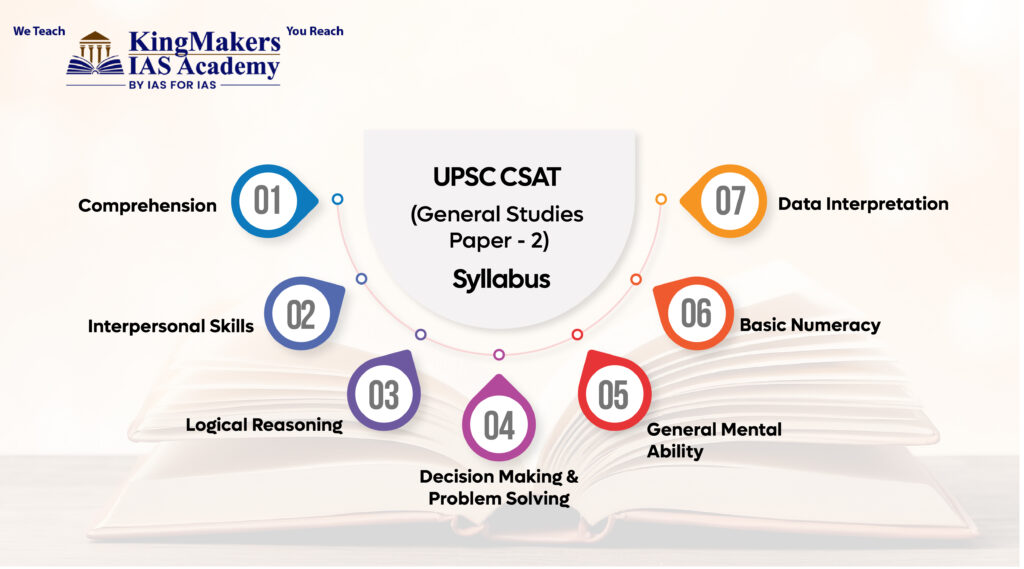
- UPSC CSAT Syllabus – Comprehension
- UPSC CSAT Syllabus – Interpersonal skills
- UPSC CSAT Syllabus – Logical Reasoning
- UPSC CSAT Syllabus – Decision Making & Problem Solving
- UPSC CSAT Syllabus – General Mental Ability
- UPSC CSAT Syllabus – Basic Numeracy
- UPSC CSAT Syllabus – Data Interpretation
1. UPSC CSAT Syllabus – Comprehension
- Main idea or central theme identification from passages
- Author’s tone, attitude, or purpose analysis
- Direct factual recall from the text
- Inference-based questions on implied meanings
- Summary or paraphrase selection for the passage
- Title or heading choice that best fits content
- Assumption or presupposition detection
- Strengthening/weakening passage arguments
- Counterargument or conclusion evaluation
2. UPSC CSAT Syllabus – Interpersonal skills
- Appropriate response selection in conversations
- Conflict resolution between colleagues or teams
- Handling sensitive feedback or criticism
- Ethical dilemmas in workplace interactions
- Negotiation tactics in group discussions
- Empathy demonstration in client dealings
- Leadership communication in crisis
- Cultural sensitivity in diverse teams
3. UPSC CSAT Syllabus – Logical Reasoning
- Syllogism-based conclusions and contradictions
- Assumptions underlying given statements
- Argument strengthening or weakening options
- Coding-decoding of words, numbers, or symbols
- Alphabetical or numerical series completion
- Direction sense and distance calculations
- Seating arrangement (linear/circular)
- Input-output machine patterns
- Classification and odd-one-out identification
4. UPSC CSAT Syllabus – Decision Making & Problem Solving
- Ethical choice in resource allocation dilemmas
- Prioritization during emergencies or crises
- Corruption or integrity testing situations
- Team management under constraints
- Public grievance resolution strategies
- Risk assessment in implementation plans
- Fairness in disciplinary actions
- Innovation in problem-solving approaches
- Long-term vs short-term decision impacts
5. UPSC CSAT Syllabus – General Mental Ability
- Number, letter, or figure series completion
- Direction and displacement calculations
- Venn diagram-based set relationships
- Mirror/water image reflections
- Embedded figures or figure completion
- Cube/dice unfolding and counting
- Analogy questions (verbal/non-verbal)
6. UPSC CSAT Syllabus – Basic Numeracy
- Simplification and BODMAS operations
- HCF/LCM of numbers and applications
- Fractions, decimals, and percentage conversions
- Profit/loss, discount, and marked price
- Simple/compound interest calculations
- Ratio, proportion, and variation problems
- Time-speed-distance and relative speed
- Time-work efficiency and pipes-cisterns
- Mensuration (area, volume, perimeter)
7. UPSC CSAT Syllabus – Data Interpretation
- Bar graphs for category comparisons
- Pie charts for percentage distributions
- Line graphs tracking changes over time
- Table data extraction and calculations
- Data sufficiency yes/no judgments
- Ratio or proportion from datasets
- Multi-graph comparison questions
Make use of the CSAT classes conducted by our KingMakers Faculty Mr. Ayyapan to strengthen your answering skills required to clear the UPSC CSAT examination,

Preparation Tips to Crack the Questions Comes Under UPSC CSAT Examination
Below, we have given the best strategies and tips for your UPSC CSAT (Civil Services Aptitude Test) examination:
- Understand the Syllabus: It will always be a first and foremost task, regardless of the examination. Ensure to understand the UPSC CSAT syllabus well in order to boost your preparation.
- Practice Reading Daily: Focus on allocating the reading tasks daily and check it off. This daily practice elevates the comprehension skills of the UPSC candidates to new heights.
- Gain Mastery in Basic Numeracy: Even though maths might not be the strongest areas of yours, acquiring the Class 10 mathematical skills like percentages, simple interest, time and work can lead you a long way.
- Develop Reasoning Skills: Only through practice, you can improve your reasoning skills. So, practice the riddles, solve puzzles, and do online mock tests to sharpen your reasoning capacity.
- Solve Previous year question papers: This enables you to get the sense of question trends and difficulty levels of the question types. Analyzing and practicing the previous year question papers can greatly increase the possibility of cracking the UPSC CSAT exam.
Below, we have provided the complete playlist containing the tips and strategies to solve the questions in the UPSC CSAT examination,
FAQs: UPSC CSAT Syllabus
1. Is UPSC CSAT important for clearing qualifying the Prelims stage?
Yes, UPSC CSAT is a mandatory qualifying paper in the Preliminary examination. Candidates must score a minimum of 33% (66.67 marks out of 200) for their GS Paper-1 to be evaluated. By failing, it leads to disqualification from the UPSC exam, irrespective of GS-1 marks.
2. What is the difficulty level of UPSC CSAT questions?
The difficulty level of UPSC CSAT falls between moderate to high, specially in comprehension and reasoning sections. Though the syllabus is based on Class 10 standards, the application-based questions need strong analytical ability and consistent practice.
3. What section carries the highest weightage in UPSC CSAT?
Generally, comprehension and logical reasoning have the highest weightage among all the sections. It tests the candidates’ reading ability, inference skills, and decision-making capacity, making them crucial for clearing the qualifying cutoff.
4. Is negative marking applicable in UPSC CSAT?
Yes, UPSC CSAT has negative marking. For every incorrect answer, one-third of the marks (0.83 marks) will be deducted. Therefore, candidates must attempt questions strategically to avoid loss of marks.
5. Can non-maths students clear UPSC CSAT?
Absolutely. UPSC CSAT does not test advanced mathematics. With a structured practice plan and focused preparation on basic numeracy, reasoning, and comprehension, even non-maths background candidates can clear the CSAT paper.